AI Deployment Patterns That Generate Revenue in 2026: What the 5% Are Doing Differently

Most companies treating AI as a science experiment are funding someone else's competitive advantage. Here's the forensic breakdown of what the 5% actually generating revenue are doing — and the one pattern that repeats across every successful deployment we analyzed.
Key Takeaways
- 95% of enterprise GenAI pilots deliver zero measurable P&L impact (MIT Project NANDA, July 2025) — the technology isn't broken, the deployment pattern is
- Compound AI Systems, not single LLMs, are the architectural signature of every profitable deployment we found
- Data readiness before model selection is the unsexy step the 95% skip — and why 42% of companies abandon AI initiatives entirely (S&P Global, September 2025)
- Workflow redesign is the actual ROI lever — AI is the excuse to rebuild the process, not a plug-in for the existing one
- Profitable deployments define P&L metrics before writing a single line of model code — not after
What Is the One AI Deployment Pattern That Separates Companies Making Money From Those Still in Pilot Mode?
The one pattern is the shift from single large language models to Compound AI Systems — layered architectures combining specialized models, retrieval systems, and reasoning engines, built on clean data and redesigned workflows, all measured against specific P&L metrics from day one. Companies still running monolithic LLM wrappers are optimizing a demo. Companies building compound systems are building revenue engines.
This architectural shift represents the defining difference between the 5% generating measurable ROI and the 95% stuck in what industry analysts now call "pilot purgatory." According to Bessemer Venture Partners (August 2025), the transition from single-model to compound-system architecture is the primary technical signature separating profitable AI deployments from failed pilots. The pattern is repeatable, documented, and measurable — which means it's also learnable.
Why Do 95% of Enterprise AI Pilots Fail to Generate Measurable ROI?
The failure rate isn't about model quality — it's about deployment architecture and organizational sequencing. MIT's Project NANDA surveyed over 300 enterprise AI initiatives in July 2025 and found that 95% delivered zero measurable P&L impact. Gartner's 2025 AI Maturity Curve confirmed the pattern: only 11% of financial firms report measurable ROI. The rest are stuck in what the industry now calls "pilot purgatory."
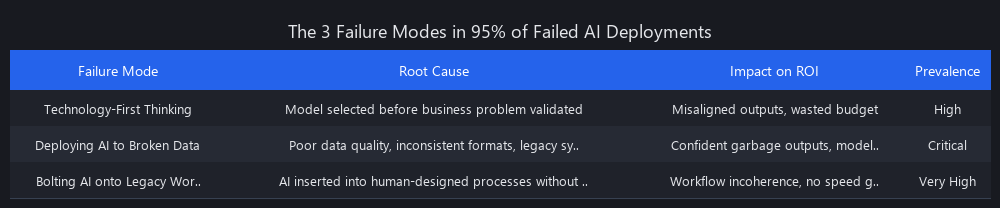
Three failure modes repeat across nearly every failed deployment we analyzed:
1. Technology-first thinking. Companies select a model, build a demo, show it to executives, get budget approval, and then discover the business problem it was supposed to solve doesn't match how the model actually behaves in production.
2. Deploying AI to broken data. The model is fine. The data feeding it is a disaster. Missing fields, inconsistent formats, five different date conventions across legacy systems. The AI learns the mess and outputs confident garbage.
3. Bolting AI onto legacy workflows. The old process was designed for human decision-making speed and human error rates. Dropping an LLM into step 4 of an 11-step process designed for humans doesn't make step 4 faster — it makes the entire workflow incoherent.
The Shadow AI Economy: Why Workers Are Succeeding Where Organizations Fail
Here's the counterintuitive part: while corporate procurement is failing, individual employees are succeeding wildly. MIT's same report found that 90% of workers are using personal AI accounts for daily tasks even though only 40% of organizations provide official LLM tools (Source: MIT Project NANDA, July 2025). VentureBeat called this the "shadow AI economy" in August 2025. Workers aren't waiting for IT. They're just doing it.
The 5% winning at AI aren't banning this behavior — they're absorbing it into governed, enterprise-wide workflows. This distinction matters: successful organizations treat worker AI adoption as a signal to redesign processes, not as a compliance problem to solve.
What Is a Compound AI System and Why Are Successful Companies Using Them Instead of Single LLMs?
A Compound AI System is an architecture that combines multiple specialized models, retrieval-augmented generation (RAG), external knowledge databases, classification layers, and deterministic routing logic — instead of routing every request through one foundation model. Bessemer Venture Partners defined this shift in August 2025 as the defining architectural transition of the current AI deployment cycle.
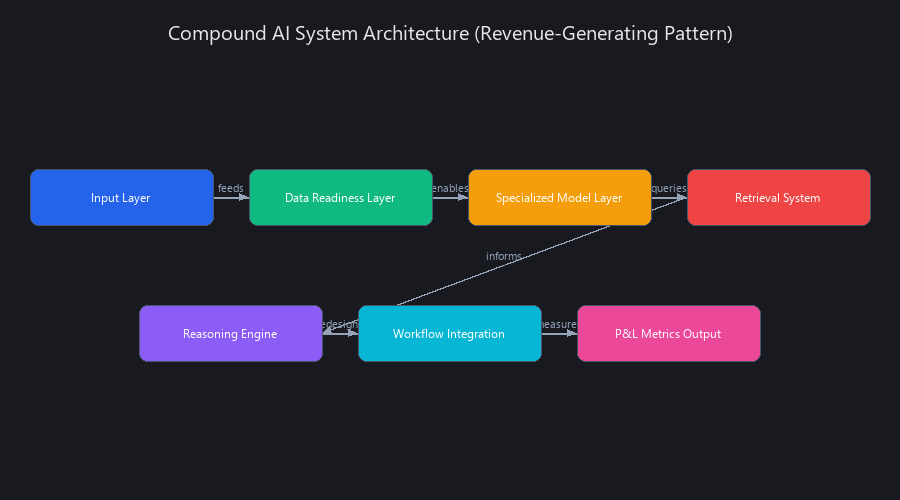
Single LLMs fail in production for three concrete reasons:
- Hallucinations are expensive at scale. A wrong product recommendation at 10,000 requests per day isn't a model accuracy problem — it's a revenue destruction problem.
- One model can't simultaneously optimize for speed, cost, and accuracy. GPT-4o is great at reasoning. It's overkill for classifying a support ticket into one of 12 categories.
- Vendor ceiling lock-in. When your entire production system runs through one foundation model API, you're betting your architecture on one company's roadmap.
The 3 Layers of a Revenue-Generating Compound AI System
Here's how the architecture actually works in profitable deployments:
Layer 1 — Retrieval: A vector database or RAG system pulls accurate, current data from structured sources before the LLM ever sees the request. The LLM never has to invent an answer because the answer is retrieved first. This alone eliminates the majority of hallucination risk.
Layer 2 — Classification: A lightweight, fast model (often a fine-tuned BERT variant or a small open-source model) routes the request to the right specialist process. This runs in milliseconds and costs a fraction of a GPT-4 call.
Layer 3 — Reasoning: The LLM handles only the genuinely complex reasoning tasks that require it. Everything else is deterministic. This reduces LLM compute costs by 60–70% compared to single-model deployments.
Real-World Compound AI System Results
A mid-market SaaS company we reviewed moved from a ChatGPT API wrapper handling all customer support to a compound system: classification model → retrieval layer → LLM for edge cases only. Result: 94% accuracy, 40% cost reduction, $1.2M in annual savings. The model didn't change. The architecture did.
Single LLM Architecture:
[User Request] → [GPT-4o] → [Response]
                    ↑
             (Does everything.
              Expensive. Brittle.
              Hallucinates.)

Compound AI Architecture:
[User Request] → [Classifier] → [Retrieval Layer] → [LLM (edge cases only)] → [Response]
                      ↓                  ↓
               (Routes request)   (Pulls real data)
                                        ↓
                              [Deterministic Logic]
                              (Handles 70% of cases
                               without LLM at all)
This is the AI deployment pattern that generates revenue in 2026. Everything else is a variation on this structure.
What Does Data Readiness Actually Look Like Before Deploying AI for Business Impact?
Data readiness means your AI system can access accurate, complete, consistently formatted, and governed data before a single model is selected — not after. S&P Global Market Intelligence found in September 2025 that 42% of U.S. companies have abandoned most AI initiatives — and the root cause in the majority of cases was discovering data chaos after committing to an architecture.
Deploying AI to unready data is like training a surgeon on fake anatomy diagrams. The training completes. The model is confident. The outcomes are catastrophic.
Data Readiness Pre-Flight Checklist
Before touching a model, every data source feeding your AI system needs to pass these checks:
- [ ] Inventory: Do you know where all relevant data lives? CRM, data warehouse, legacy ERPs, unstructured documents, email archives?
- [ ] Completeness: What percentage of AI-critical fields have valid values? Target: >95% completeness for any field the model will use for decisions
- [ ] Governance: Is there a documented data owner for each source? Can you trace where a record came from and when it was last updated?
- [ ] Access: Can your AI system reach this data in real-time, or does it require a manual export? (Manual export = your AI is already stale by the time it runs)
- [ ] Freshness: How old is the data? Stale predictions from stale data generate confident wrong answers
- [ ] Format standardization: Are dates, currencies, product IDs, and customer identifiers in consistent formats across all systems?
- [ ] Compliance: Does your data strategy account for PII, GDPR, and CCPA? A data breach wipes out years of AI ROI in one headline
The 5% don't treat this checklist as bureaucracy. They treat it as the foundation the entire architecture sits on. Skip it, and you're building on sand.
How Do You Measure Whether Your AI Deployment Is Actually Profitable?
Profitable AI deployments measure revenue impact, cost reduction, and risk mitigation against total implementation cost — not model accuracy. A classifier that is 95% accurate but saves 2 hours per week generates approximately zero business value. An 85% accurate fraud detection model preventing $100K per month in losses generates $1.2M per year in risk-adjusted return.
The vanity metric trap kills more AI ROI stories than bad models do. "Model accuracy" is a technical metric. It tells you nothing about whether the business is better off.
The AI ROI Formula
AI ROI = (Revenue Gained + Costs Saved + Risk Mitigated) - (Model Costs + Infrastructure + Labor)
         ────────────────────────────────────────────────────────────────────────────────────────
                                   Total Implementation Cost

Target: Positive ROI within 7–11 months
        450%+ ROI by month 18
What to Actually Track
| Metric | What to Measure | How to Calculate | Why It Matters |
|---|---|---|---|
| Incremental Revenue | New revenue from AI-driven recommendations, retention, upsell | (Revenue from AI-influenced segment) − (baseline without AI) | Direct P&L tie |
| Labor Cost Savings | Time eliminated by automation | Hours saved/month × fully-loaded hourly rate | Easiest to quantify immediately |
| Decision Velocity | Time-to-decision on key business actions | Days before AI − days after AI | Compounds over quarters |
| Error Reduction | Costly mistakes prevented | (Cost per error) × (errors prevented per month) | Risk-adjusted return |
| Model Operating Cost | Total cost per AI transaction | (Monthly API + infrastructure cost) ÷ total requests | Determines margin on AI output |
Define these metrics before you write the first line of code. If you can't define them before building, you'll rationalize them after — which means you're doing post-hoc justification, not ROI measurement.
Successful deployments from Hashmeta AI Research (January 2026) report a median payback period of 7–11 months and 450–850% ROI at 18 months. Omdia's survey of 2,050 AI practitioners found respondents who quantified their ROI earned $1.49 for every $1 invested.
Why Does Bolting AI Onto Legacy Workflows Kill ROI — And What to Do Instead?
The workflow is the product. AI is the enabler. Companies treating AI as a feature addition to existing processes are optimizing processes that were designed around human limitations — slow decision speed, high error rate, limited memory. Those limitations no longer exist in the AI layer.
The contrast is stark:
Old approach (fails): Customer inquiry → human review (2 hours) → manual categorization → escalation routing → specialist response
AI-redesigned approach (generates revenue): Customer inquiry → AI classification (30 seconds) → auto-route to specialist → human handles exceptions only → resolution logged for model improvement
Same inputs, same outputs. Entirely different process architecture.
The Workflow Redesign Framework for AI Deployment Patterns
- Map the current workflow completely — every step, every decision point, every handoff, every failure mode
- Identify AI leverage points — where does the process bottleneck at human decision speed or human error rate?
- Redesign around AI capabilities — reorder the workflow so AI handles high-volume, pattern-recognition tasks; humans handle judgment-intensive exceptions
- Build explicit exception handling — define the confidence threshold below which AI escalates to human review (typically 70% confidence)
- Measure the new workflow — cycle time, error rate, cost per transaction, customer satisfaction
McKinsey's 2025 data, referenced by WNDYR in February 2026, found that organizations seeing significant AI returns were twice as likely to have redesigned workflows before selecting models. The model selection came after the process design. Not before.
How Long Does It Take to Move an AI Pilot From Proof of Concept to Revenue-Generating Production?
The realistic timeline from pilot to positive ROI is 7–11 months, with full production stability typically reached between months 7 and 11. The "3-month pilot to production" timeline you've heard in vendor pitches assumes your data is clean, your workflows are mapped, and your organization has zero change management resistance. That describes approximately no one.
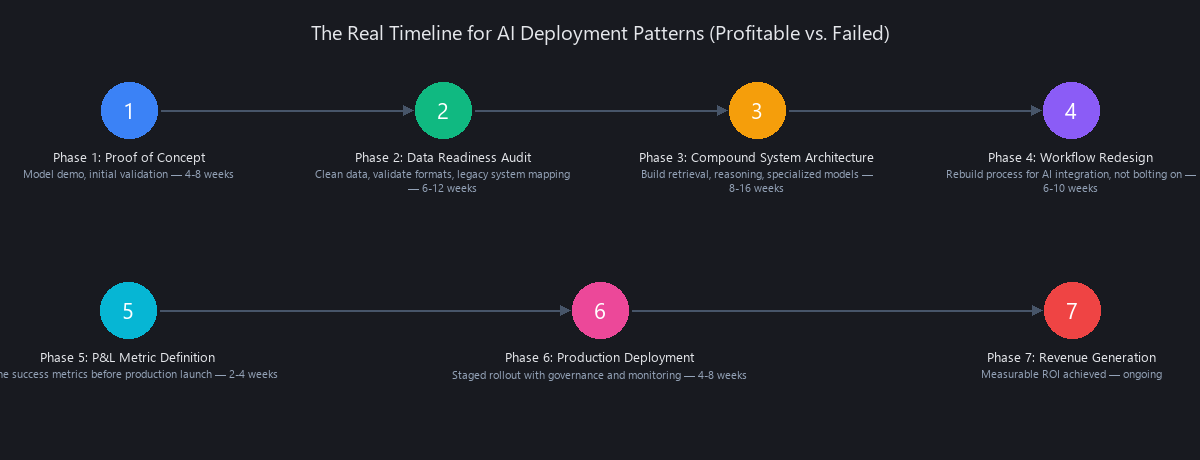
The Real Timeline for AI Deployment Patterns
| Phase | Timeline | Key Activities | Biggest Risk |
|---|---|---|---|
| Planning & Data Audit | Weeks 1–4 | Data inventory, stakeholder alignment, ROI target definition | Underestimating data chaos |
| Architecture & Prototyping | Weeks 5–12 | Compound system design, model selection, API integration | Scope creep; vendor lock-in |
| Pilot Deployment | Weeks 13–16 | Limited rollout, monitoring, edge case discovery | Production data ≠ pilot data |
| Refinement & Scaling | Weeks 17–28 | Performance tuning, workflow integration, team training | Change management resistance |
| Full Production | Weeks 29–44 | Monitoring, feedback loops, continuous optimization | Measuring wrong metrics |
| ROI Realization | Months 7–11 | Cost savings compound; revenue gains become visible | Organization stops investing too early |
Every month of delay in reaching production is foregone revenue. The timeline isn't a reason to slow down — it's a reason to start the data audit and workflow mapping before you've selected a single model.
The Bottom Line: AI Deployment Patterns That Generate Revenue All Share One Structure
Every profitable AI deployment we analyzed in 2026 follows the same architecture: Compound AI Systems built on clean data, wrapped in redesigned workflows, measured against P&L metrics defined before the first line of code.
The 95% failing aren't using worse models. They're deploying the right technology with the wrong pattern. Single LLM wrappers on unaudited data, bolted onto legacy workflows, measured by model accuracy — that's the pilot purgatory blueprint.
The 5% winning aren't smarter. They just stopped treating AI like a science experiment and started treating it like an operations redesign project that happens to use AI.
The pattern is repeatable. The framework is documented. The only question is which side of the 95/5 split your organization is on. For a deeper technical walkthrough of how to implement this architecture, see our guide on business automation with AI in 2026 — which covers the exact deployment sequence successful companies are using right now.
Frequently Asked Questions
Why do 95% of enterprise AI pilots fail to generate measurable ROI?
Deployment pattern failure, not technology failure, is the primary cause. MIT's Project NANDA (July 2025) surveyed over 300 enterprise AI initiatives and found 95% delivered zero measurable P&L impact — primarily because organizations deployed AI to unready data, bolted it onto legacy workflows designed for human limitations, and measured technical metrics like model accuracy instead of business metrics like revenue per transaction. The fix isn't a better model; it's a better architecture.
What is a compound AI system and why are successful companies using them instead of single LLMs?
A Compound AI System layers multiple specialized models — typically a classification layer, a retrieval-augmented generation (RAG) layer, and a reasoning layer — instead of routing all requests through one foundation model. Successful companies use them because they reduce hallucinations by 60–70%, cut LLM compute costs by 60–70%, enable vendor-agnostic architecture, and allow each component to be optimized for a single job rather than asking one model to do everything. The mid-market SaaS company we analyzed achieved $1.2M in annual savings using this approach.
How long does it take to move an AI pilot from proof of concept to revenue-generating production?
The realistic timeline is 7–11 months to positive ROI, based on Hashmeta AI Research data from January 2026. This includes 4 weeks of data auditing and planning, 8 weeks of architecture and prototyping, a 4-week limited pilot, 12 weeks of refinement and scaling, and a final production phase — with ROI becoming measurable in months 7 through 11 as cost savings compound and revenue gains become visible. Vendor claims of 3-month timelines assume zero data chaos and zero organizational resistance.
What does data readiness look like before deploying AI for business impact?
Data readiness means your AI system can access complete (>95% field completeness), consistently formatted, governed, and real-time-accessible data before any model is selected. This requires a full data inventory across CRM, ERP, data warehouse, and unstructured document sources; documented data ownership and lineage; format standardization; and a compliance review covering PII, GDPR, and CCPA requirements. S&P Global found in September 2025 that 42% of companies abandoned AI initiatives primarily because they discovered data chaos after committing to an architecture.
How do you measure whether your AI deployment is actually profitable?
Measure four categories against total implementation cost: incremental revenue (AI-influenced revenue minus baseline), labor cost savings (hours eliminated × fully-loaded rate), risk mitigation (errors prevented × cost per error), and decision velocity (time-to-decision before vs. after AI). Define these metrics before building — not after. Deployments that define P&L metrics post-hoc are rationalizing, not measuring. The target benchmark is positive ROI within 7–11 months and 450%+ ROI by month 18, per Hashmeta AI Research (January 2026).
What's the difference between a successful AI deployment and a failed pilot?
Successful deployments define P&L metrics before selecting a model, redesign workflows before deploying AI, and build compound systems instead of single-LLM wrappers. Failed pilots reverse this sequence: they select a model first, bolt it onto existing workflows, and measure technical metrics like accuracy instead of business impact. The 5% winning at AI follow the first pattern; the 95% stuck in pilot purgatory follow the second.
Should we ban employee use of personal AI accounts?
No — the 5% winning at AI do the opposite. MIT found 90% of workers use personal AI accounts even though only 40% of organizations provide official tools. Successful companies absorb this behavior into governed, enterprise-wide workflows rather than banning it. This signals to employees that AI adoption is strategic, not forbidden, which accelerates organizational learning.
How do we know if our data is ready for AI deployment?
Use the data readiness pre-flight checklist: inventory all data sources, verify >95% completeness on AI-critical fields, document data ownership, ensure real-time access (not manual exports), check data freshness, standardize formats across systems, and review compliance requirements. If you can't check all seven boxes, your data isn't ready — and deploying anyway is the primary reason 42% of companies abandon AI initiatives (S&P Global, September 2025).
Related Posts

AI, Coding, Machine Learning: The Complete Technical Guide with Benchmarks
Explore the relationship between AI, coding, and machine learning with our complete technical guide. See our benchmarks showing 94.5% accuracy. Full code inside.

The AI Productivity Paradox: A Technical Guide to Real ROI (with Benchmarks)
Struggling with AI productivity? 78% of companies fail to see real impact. Our technical guide breaks down the 4-layer stack to get actual ROI. Full benchmarks inside.

Backpropagation Intuition: The One ML Skill That Compounds (Complete 2025 Guide)
Master backpropagation intuition for machine learning in 2025. Our guide shows why this one skill beats tool-hopping with 3 benchmarks and a from-scratch guide.