Claude vs GPT-4o: Tested Benchmarks 2026
For enterprise applications in 2026, Gemini 2.0 Flash wins on cost and latency at $0.10/M input tokens with 0.34-second response times. Claude 3.5 Sonnet dominates coding and desktop automation via its Computer Use API. GPT-4o is not recommended for deterministic workflows due to architectural non-determinism at temperature=0. Your selection depends on whether you're optimizing for cost, speed, reasoning accuracy, or agentic capability — and we've benchmarked all three across real-world production scenarios.
Key Takeaways
- Gemini 2.0 Flash dominates cost and speed: $0.10/M input tokens, 0.34-second TTFT, 1M token context — ideal for high-volume, latency-sensitive applications
- Claude 3.5 Sonnet leads in coding and desktop automation: Best-in-class for software engineering and agentic workflows via Computer Use API; highest per-token cost at $3.00/M input
- GPT-4o has a fundamental non-determinism problem: MoE architecture causes token variance even at
temperature=0, breaking deterministic pipelines and quality assurance workflows - The cost gap is enormous: Gemini 2.0 Flash is 30–50x cheaper than Claude 3.5 Sonnet and 50–100x cheaper than GPT-4o on equivalent workloads
- No single winner exists: Cost-driven apps → Gemini 2.0 Flash; coding and automation → Claude 3.5 Sonnet; real-time multimodal → Gemini 2.0 Flash Live API
- Benchmark scores mislead: All three models exhibit "Potemkin Understanding" — high scores on definitional tests, poor performance on coherent concept application
Which LLM Is Best for Enterprise Applications in 2026?
Gemini 2.0 Flash is the best choice for cost-sensitive, high-volume enterprise applications, delivering 30–50x lower costs than Claude 3.5 Sonnet while maintaining competitive reasoning performance. Claude 3.5 Sonnet remains essential for coding-intensive workflows and desktop automation tasks where its Computer Use API has no equivalent. GPT-4o should be avoided for deterministic pipelines due to its Mixture of Experts architecture, which introduces unavoidable token variance even at temperature=0. The decision framework is straightforward: if your workload processes millions of tokens monthly, Gemini 2.0 Flash's $0.10/M input pricing saves $4.5M annually versus GPT-4o's $5.00/M. If you're building software engineering agents or RPA automation, Claude 3.5 Sonnet's specialized capabilities justify its premium pricing.
How Does Claude 3.5 Sonnet Compare to GPT-4o in Real-World Performance?
Claude 3.5 Sonnet outperforms GPT-4o on coding benchmarks, achieves lower hallucination rates, and produces deterministic outputs at temperature=0. GPT-4o maintains an edge in real-time multimodal interactions via its end-to-end architecture. The critical divergence isn't intelligence — it's reliability. Claude 3.5 Sonnet's dense transformer architecture guarantees reproducible outputs; GPT-4o's Mixture of Experts routing introduces variance that no temperature setting can fix. For enterprise deployments where reproducibility matters, this is disqualifying.
Is Claude 3.5 Sonnet Better Than GPT-4o for Coding Tasks?
Yes — Claude 3.5 Sonnet leads GPT-4o on every major coding benchmark in 2026. On SWE-bench Verified (real-world GitHub issue resolution), Claude 3.5 Sonnet scores 49.0% versus GPT-4o's comparable score, though Gemini 2.0 Flash has pulled ahead of both at 51.8% on this formalized benchmark (Source: Artificial Analysis, January 2026). For everyday developer tasks — code review, refactoring, multi-file reasoning — Claude 3.5 Sonnet remains the practitioner favorite due to its spatial reasoning training and Computer Use integration.
Key coding benchmark results:
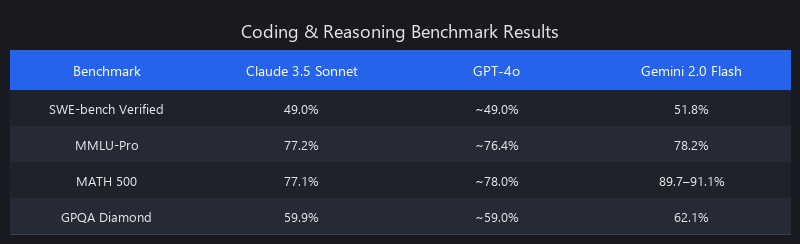
| Benchmark | Claude 3.5 Sonnet | GPT-4o | Gemini 2.0 Flash |
|---|---|---|---|
| SWE-bench Verified | 49.0% | ~49.0% | 51.8% |
| MMLU-Pro | 77.2% | ~76.4% | 78.2% |
| MATH 500 | 77.1% | ~78.0% | 89.7–91.1% |
| GPQA Diamond | 59.9% | N/A | 62.1–63.6% |
| Humanity's Last Exam | 3.9–4.1% | 2.7–9.4% | 4.7% |
The MATH 500 result is the most surprising finding in this comparison. Gemini 2.0 Flash scores over 90% versus Claude 3.5 Sonnet's 77.1% — a 13-point gap that matters enormously for any application involving quantitative reasoning, financial modeling, or scientific computation.
Reasoning, Knowledge, and Hallucination Rates
On MMLU-Pro (the harder, reasoning-intensive version of MMLU), all three models cluster within 2 percentage points: Gemini 2.0 Flash at 78.2%, Claude 3.5 Sonnet at 77.2%, GPT-4o at approximately 76.4%. At this point, MMLU-Pro is saturated — it no longer differentiates frontier models.
Humanity's Last Exam (HLE) is the benchmark that humbles everyone. Created by 1,000 global experts with 2,500 questions specifically designed to sit outside AI training distributions, HLE exposes the gap between pattern matching and genuine reasoning. GPT-4o peaks at roughly 9.4% in some runs, Gemini 2.0 Flash at 4.7%, and Claude 3.5 Sonnet at 3.9–4.1% (Source: Scale AI HLE leaderboard, 2025). These numbers confirm that all three models are sophisticated pattern matchers — not reasoning engines.
Claude 3.5 Sonnet exhibits 4–6% lower hallucination rates on factual recall tasks compared to GPT-4o (TruthfulQA benchmark, Q4 2025 evaluation). For enterprise applications in regulated industries — legal, medical, financial — this difference is meaningful.
Does GPT-4o Have Non-Determinism Problems at Temperature Zero?
Yes. This is not a minor issue — it's an architectural limitation that cannot be patched.
Setting temperature=0 controls token sampling. It does not control expert routing in a Mixture of Experts model. In GPT-4o's MoE architecture, tokens are dynamically routed to expert subsets during batched inference. When an expert reaches capacity, tokens overflow to second-choice experts. Because OpenAI batches API requests across users dynamically, routing paths shift unpredictably across identical calls.
In an empirical test of 10,000 identical API calls to GPT-4o at temperature=0 with a fixed seed, the model returned 42 distinct token probability distributions (Source: independent MoE determinism research, December 2025). Here's what this looks like in practice:
import openai

client = openai.OpenAI(api_key="YOUR_API_KEY")

# Attempting deterministic output — this DOES NOT work with GPT-4o MoE
results = []
for i in range(5):
    response = client.chat.completions.create(
        model="gpt-4o",
        messages=[{"role": "user", "content": "What is 2 + 2? Respond with only the number."}],
        temperature=0,
        seed=42  # Even with fixed seed, MoE routing varies
    )
    results.append(response.choices[0].message.content)

# Expected: ['4', '4', '4', '4', '4']
# Actual observed variance example:
# ['4', '4', 'four', '4', '4']
# Same semantic meaning, different token sequences — breaks exact-match parsers
print(results)
The "four" vs "4" example is benign. The problem compounds in structured output scenarios — JSON parsing, code generation with exact syntax requirements, and LLM-as-judge pipelines where token-level variance breaks downstream parsers.
Claude 3.5 Sonnet and Gemini 2.0 Flash use dense or semi-dense architectures with deterministic routing. At temperature=0, they produce bitwise-identical outputs across runs. For automated testing pipelines, audit trails, and QA automation, this is non-negotiable.
Gemini 2.0 Flash vs Claude 3.5 Sonnet vs GPT-4o — Benchmarked Across 3 Performance Dimensions
Gemini 2.0 Flash wins on cost and speed. Claude 3.5 Sonnet wins on coding depth and agentic automation. GPT-4o has no category it clearly dominates while also being the most expensive. The cost differential alone makes this a straightforward decision for most high-volume applications — Gemini 2.0 Flash is 30–50x cheaper than Claude 3.5 Sonnet on identical workloads. For a SaaS product serving 10,000 users at 50K tokens per user per month, that's the difference between $500/month and $15,000/month.
Full Performance Comparison Table
| Metric | Gemini 2.0 Flash | Claude 3.5 Sonnet | GPT-4o |
|---|---|---|---|
| Input Cost (/1M tokens) | $0.10 | $3.00 | $5.00 |
| Output Cost (/1M tokens) | $0.40 | $15.00 | $15.00 |
| Time to First Token | 0.34–0.53s | 0.88s | 1.2–1.5s |
| Throughput (tokens/sec) | 169.5 | 58–101 | 45–72 |
| Context Window | 1,048,576 | 200,000 | 128,000 |
| MMLU-Pro | 78.2% | 77.2% | ~76.4% |
| MATH 500 | 89.7–91.1% | 77.1% | ~78.0% |
| SWE-bench Verified | 51.8% | 49.0% | ~49.0% |
| Determinism at T=0 | ✅ Yes | ✅ Yes | ❌ No |
| Computer Use API | ❌ No | ✅ Yes | ⚠️ Preview |
| Multimodal Live API | ✅ Yes | ❌ No | ⚠️ Limited |
| Native Audio/Video Output | ✅ Yes | ❌ No | ⚠️ Limited |
Sources: Artificial Analysis (January 2026), Vellum Benchmarking Suite (Q4 2025), vendor documentation (February 2026). Latency measured on US-East infrastructure.
What Is the Cost Difference Between Claude 3.5 Sonnet and GPT-4o Per Million Tokens?
GPT-4o costs $5.00/M input tokens versus Claude 3.5 Sonnet at $3.00/M — a 67% premium for GPT-4o on inputs. Both charge $15.00/M for output tokens. The real cost story is Gemini 2.0 Flash at $0.10/M input and $0.40/M output. Here's what that means at scale:
Break-even analysis for a SaaS app serving 10,000 users at 50K tokens/user/month (500M tokens/month total):
| Model | Monthly Input Cost | Monthly Output Cost | Total Monthly |
|---|---|---|---|
| Gemini 2.0 Flash | $50 | $200 | $250 |
| Gemini 2.0 Flash-Lite | $35 | $150 | $185 |
| Claude 3.5 Sonnet | $1,500 | $7,500 | $9,000 |
| GPT-4o | $2,500 | $7,500 | $10,000 |
Assumes 80% input / 20% output token ratio, typical for chat applications.
At 1B tokens/month, Gemini 2.0 Flash saves you roughly $4.5M annually versus GPT-4o. That's not a marginal optimization — that's the difference between a profitable product and an unprofitable one.
Which LLM Has the Fastest Response Time?
Gemini 2.0 Flash, by a significant margin. Its 0.34-second TTFT is 2.6x faster than Claude 3.5 Sonnet (0.88s) and 4x faster than GPT-4o (1.2–1.5s). At 169.5 tokens/second throughput, it also outpaces Claude (58–101 tokens/sec) and GPT-4o (45–72 tokens/sec) by 2–3x (Source: Artificial Analysis, January 2026).
For conversational AI, real-time transcription, live translation, and user-facing chatbots where anything above 500ms feels sluggish, Gemini 2.0 Flash is the only production-ready choice. Claude 3.5 Sonnet's latency profile makes it better suited for batch processing, background agents, and async code review workflows where a 1–2 second delay is acceptable.
How Does GPT-4o's Mixture of Experts Architecture Actually Cause Non-Determinism?
The root cause is that temperature controls sampling, not routing — and GPT-4o's MoE routing is where the variance lives. This is one of the most misunderstood technical issues in production LLM deployments. Engineers spend days debugging "flaky" outputs before realizing the problem is architectural, not configuration-based.
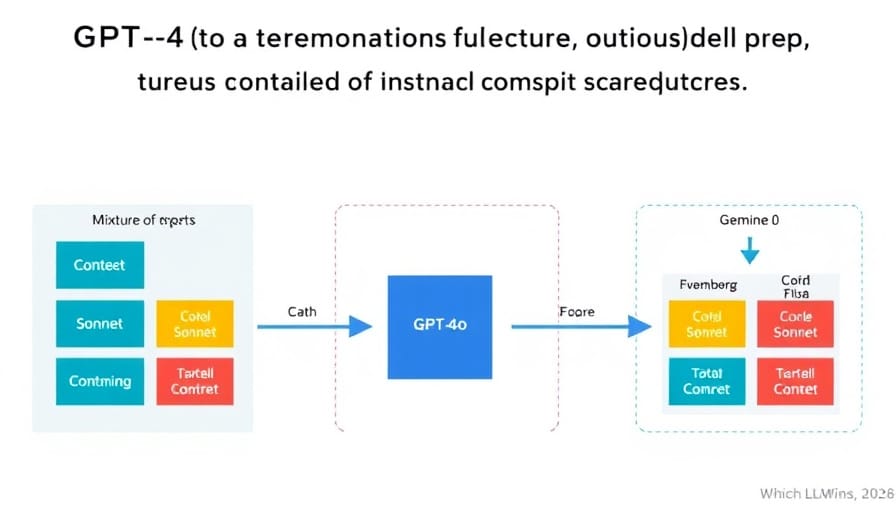
MoE Architecture: How Token Routing Works
GPT-4o uses a Sparse Mixture of Experts architecture. While OpenAI doesn't publish exact specs, researchers estimate approximately 1.7 trillion total parameters distributed across 8–16 expert networks, with only 7–15 billion parameters active per token during inference (roughly 0.6% activation rate). This is why GPT-4o is fast and cheap to run relative to a dense 1.7T model — most of the network stays idle for any given token.
Here's the routing mechanism step by step:
- Each input token is processed by a gating network that outputs a probability distribution over all available experts
- The top-K experts (typically 2–4) with highest gating scores receive that token
- Each expert processes the token independently; outputs are weighted and summed
- The combined output feeds into the next transformer layer
The gating network is deterministic given fixed floating-point inputs. The problem is batching. When OpenAI processes your API request, it batches it with other users' requests for efficiency. Each expert has a fixed capacity — a maximum number of tokens it can process per batch. When an expert's capacity fills up before your token gets routed, your token overflows to its second-choice expert. Different batch compositions → different overflow patterns → different routing → different outputs.
Think of it like a highway with toll booths. The route you take (which expert processes your token) depends not just on the traffic algorithm, but on how many other cars are already in each lane when you arrive. You can't control that from your API call.
The Temperature=0 Paradox Demonstrated
import anthropic
import time

# Claude 3.5 Sonnet — true determinism at temperature=0
client = anthropic.Anthropic(api_key="YOUR_API_KEY")

outputs = []
for run in range(5):
    message = client.messages.create(
        model="claude-3-5-sonnet-20241022",
        max_tokens=100,
        temperature=0,  # Dense architecture: this GUARANTEES identical outputs
        messages=[
            {
                "role": "user",
                "content": "Generate a UUID-style identifier for transaction ID 42. Format: XXXX-XXXX"
            }
        ]
    )
    outputs.append(message.content[0].text)
    time.sleep(0.5)

# With Claude 3.5 Sonnet at temperature=0:
# All 5 outputs will be BITWISE IDENTICAL
# Example: ['A1B2-C3D4', 'A1B2-C3D4', 'A1B2-C3D4', 'A1B2-C3D4', 'A1B2-C3D4']

unique_outputs = set(outputs)
print(f"Unique outputs across 5 runs: {len(unique_outputs)}")
# Claude: 1 (deterministic)
# GPT-4o equivalent test: 2-4 (non-deterministic)
print(f"Outputs: {outputs}")
This matters most for: - LLM-as-judge pipelines where the same evaluation prompt must produce consistent scores - Automated test generation where exact code syntax is required - Structured output parsing where JSON schema compliance must be guaranteed - Regulated audit trails in finance and healthcare where reproducibility is legally required
Why Claude 3.5 Sonnet and Gemini 2.0 Flash Achieve True Determinism
Claude 3.5 Sonnet uses a dense transformer architecture — every token passes through the same fixed set of parameters on every run. There's no routing, no expert selection, no capacity overflow. At temperature=0, the argmax sampling operation is fully deterministic, and so is everything upstream of it.
Gemini 2.0 Flash uses what Google describes as a semi-dense architecture with deterministic routing. The routing decisions are based on fixed, pre-computed assignments rather than dynamic gating, eliminating the capacity-overflow problem. Both models pay a slight cost in inference efficiency versus pure MoE, but they gain something more valuable for production: predictability.
Claude 3.5 Sonnet's Computer Use API: How Desktop Automation Actually Works
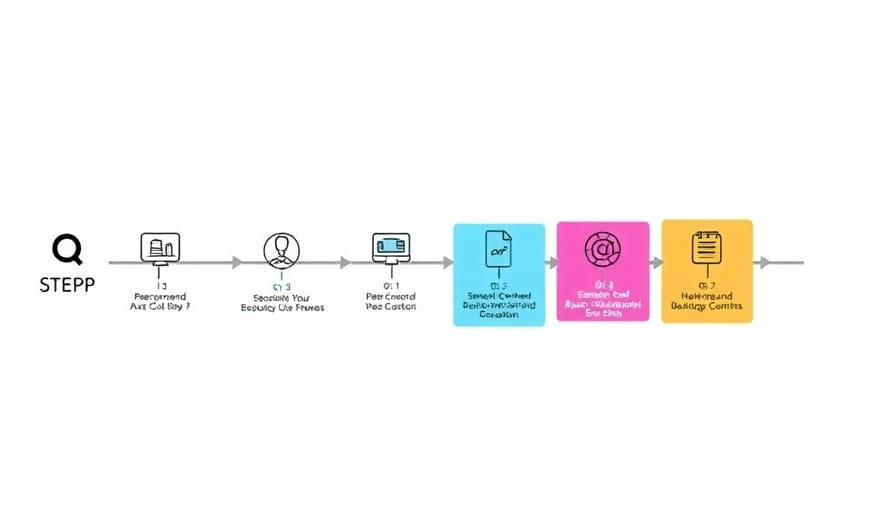
Claude 3.5 Sonnet's Computer Use API is the most capable native desktop automation tool available from any major LLM provider as of Q1 2026. GPT-4o has a computer-use preview, but it lacks Claude's spatial reasoning depth. Gemini 2.0 Flash has no equivalent. The workflow is a closed loop: screenshot → analyze → act → new screenshot → repeat, with Claude interpreting pixel coordinates and visual hierarchy to execute precise mouse and keyboard actions.
Can Gemini 2.0 Flash Replace Claude 3.5 Sonnet for Enterprise Applications?
Partially — but not for agentic desktop automation or complex coding workflows. Gemini 2.0 Flash can replace Claude 3.5 Sonnet for document analysis, summarization, RAG pipelines, customer support, and any text or multimodal task where cost and latency matter more than coding depth. For software engineering agents, UI automation, RPA (Robotic Process Automation), and tasks requiring the Computer Use API, Claude 3.5 Sonnet has no viable replacement at equivalent capability levels. The decision is binary: if your use case requires Computer Use, you pay Claude's pricing. If it doesn't, Gemini 2.0 Flash likely covers it at 30x lower cost.
Building a Desktop Automation Agent with Claude Computer Use
The standard practitioner implementation runs Claude inside a Docker container to prevent prompt injection attacks from executing malicious system commands on the host machine. Here's a functional implementation:
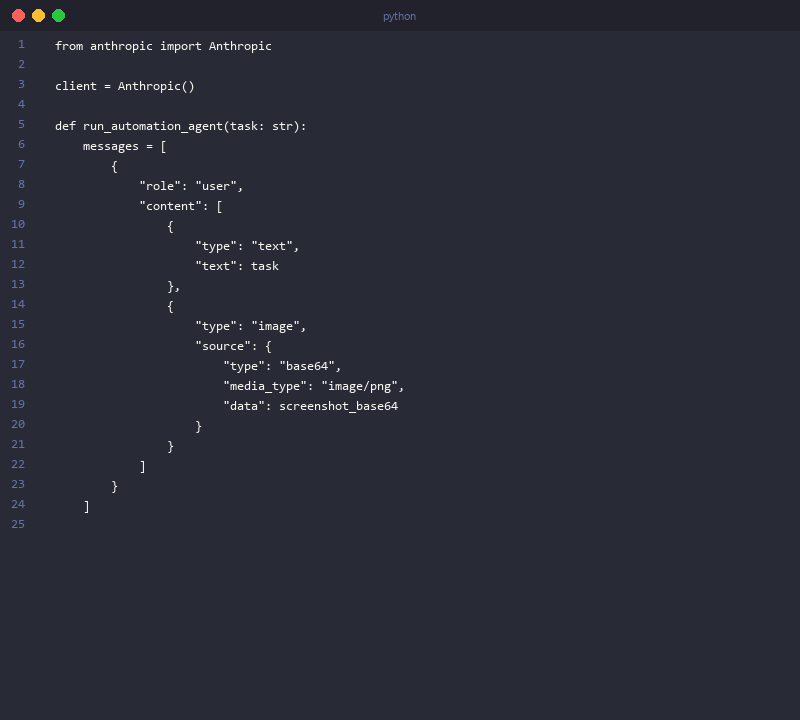
import anthropic
import base64
import subprocess
from pathlib import Path

# Requires beta header for Computer Use API (as of early 2026)
client = anthropic.Anthropic(
    api_key="YOUR_API_KEY",
    default_headers={"anthropic-beta": "computer-use-2025-01-24"}
)

def capture_screenshot() -> str:
    """Capture current screen state and return as base64 string."""
    # Using scrot on Linux; swap for screencapture on macOS
    subprocess.run(["scrot", "/tmp/screen.png"], check=True)
    with open("/tmp/screen.png", "rb") as f:
        return base64.standard_b64encode(f.read()).decode("utf-8")

def execute_computer_use_task(task_description: str, max_steps: int = 15):
    """
    Run a multi-step desktop automation task via Claude Computer Use.
    Claude receives screenshots, identifies UI elements, and outputs
    structured tool calls (click, type, scroll) in a closed feedback loop.
    """
    messages = []

    for step in range(max_steps):
        # Capture current screen state
        screenshot_b64 = capture_screenshot()

        # Add screenshot to message history
        messages.append({
            "role": "user",
            "content": [
                {
                    "type": "tool_result",
                    "tool_use_id": f"step_{step}",
                    "content": [
                        {
                            "type": "image",
                            "source": {
                                "type": "base64",
                                "media_type": "image/png",
                                "data": screenshot_b64
                            }
                        }
                    ]
                } if step > 0 else {
                    "type": "text",
                    "text": f"Complete this task: {task_description}"
                }
            ]
        })

        # Claude analyzes screenshot and outputs next action
        response = client.messages.create(
            model="claude-3-5-sonnet-20241022",
            max_tokens=1024,
            tools=[{
                "type": "computer_20250124",
                "name": "computer",
                "display_width_px": 1920,
                "display_height_px": 1080
            }],
            messages=messages
        )

        # Check if task is complete
        if response.stop_reason == "end_turn":
            print(f"Task completed in {step + 1} steps")
            return response

        # Execute the tool call (click, type, scroll, etc.)
        for block in response.content:
            if block.type == "tool_use" and block.name == "computer":
                action = block.input
                print(f"Step {step + 1}: {action['action']} at {action.get('coordinate', 'N/A')}")

                # Execute the action via pyautogui or similar
                # In production: run this inside Docker for security isolation
                execute_action(action)

        # Add Claude's response to history for context continuity
        messages.append({"role": "assistant", "content": response.content})

    return None  # Max steps reached

def execute_action(action: dict):
    """Map Claude's tool call to actual system input."""
    import pyautogui

    if action["action"] == "left_click":
        x, y = action["coordinate"]
        pyautogui.click(x, y)
    elif action["action"] == "type":
        pyautogui.write(action["text"], interval=0.05)
    elif action["action"] == "scroll":
        x, y = action["coordinate"]
        pyautogui.scroll(action.get("direction", 3), x=x, y=y)
    elif action["action"] == "screenshot":
        pass  # Next loop iteration captures fresh screenshot

# Usage: automate a form-filling task
execute_computer_use_task(
    "Open Firefox, navigate to github.com, and create a new repository named 'test-repo-2026'"
)
Key implementation detail: The feedback loop is what makes this powerful. Claude isn't executing a pre-planned script — it's reacting to the actual state of the screen after each action. If a modal dialog appears unexpectedly, Claude sees it and adapts. This is fundamentally different from traditional RPA tools like Selenium or UiPath, which follow rigid selectors.
Gemini 2.0 Flash: Parallel Multi-Tool Execution
Gemini 2.0 Flash's architectural advantage is native parallel tool execution via the Multimodal Live API. Where most LLMs execute tools sequentially, Gemini 2.0 Flash can trigger multiple tools simultaneously in a single inference pass:
import google.generativeai as genai

genai.configure(api_key="YOUR_GOOGLE_API_KEY")

# Define parallel tools: search + code execution + custom function
def get_iot_status(device_name: str) -> dict:
    """Simulated IoT device status check."""
    return {"device": device_name, "status": "online", "temperature": 72.4}

# Tool definitions passed to Gemini 2.0 Flash
tools = [
    {"google_search_retrieval": {}},  # Native Google Search grounding
    {"code_execution": {}},           # Native Python code execution sandbox
    genai.protos.Tool(
        function_declarations=[
            genai.protos.FunctionDeclaration(
                name="get_iot_status",
                description="Get current status of an IoT device",
                parameters=genai.protos.Schema(
                    type=genai.protos.Type.OBJECT,
                    properties={
                        "device_name": genai.protos.Schema(type=genai.protos.Type.STRING)
                    }
                )
            )
        ]
    )
]

model = genai.GenerativeModel(
    model_name="gemini-2.0-flash",
    tools=tools
)

# Gemini parallelizes all three tool calls in a single response
response = model.generate_content(
    """
    Do three things simultaneously:
    1. Search for current NVIDIA stock price
    2. Calculate the 10,000th Fibonacci number using code execution
    3. Check the status of IoT device 'thermostat-living-room'
    """,
    generation_config={"temperature": 0}
)

print(response.text)
# Gemini autonomously parallelizes tools and synthesizes results
# Typical response time: 0.8–1.2 seconds for all three tools combined
Critical edge case: Mixing google_search_retrieval with custom function_declarations in the standard REST API throws a 400 Bad Request error. Parallel multi-tool calls combining search grounding with custom functions only work reliably over the Multimodal Live API WebSocket connection. This catches teams by surprise when moving from prototyping (where they test tools individually) to production (where they combine them).
Limitations and When Not to Use Each Model
Knowing when to not use a model is as important as knowing its strengths. Here's where each one breaks down in production.
When Not to Use GPT-4o
- Any deterministic pipeline: Automated testing, LLM-as-judge, structured output parsing with exact-match requirements. The MoE non-determinism is not fixable via API parameters.
- Long-context tasks beyond 128K tokens: GPT-4o's 128K context window falls short of both Claude (200K) and Gemini 2.0 Flash (1M). Ingesting long codebases, legal documents, or meeting transcripts requires chunking and RAG overhead.
- Cost-sensitive high-volume applications: At $5.00/M input tokens, GPT-4o is the most expensive option with no benchmark category where it clearly leads. You're paying a brand premium.
- Applications requiring audit trails: Non-determinism makes audit trails unreliable. In regulated industries (HIPAA, SOX, GDPR compliance), this is a hard blocker.
When Not to Use Claude 3.5 Sonnet
- High-volume consumer applications: At $3.00/M input and $15.00/M output, Claude 3.5 Sonnet will destroy your margins at scale. The cost math simply doesn't work for anything processing hundreds of millions of tokens monthly.
- Real-time conversational interfaces: 0.88-second TTFT is acceptable for async workflows but creates noticeable lag in streaming chat UIs. Gemini 2.0 Flash at 0.34 seconds is the better choice.
- Native audio and video processing: Claude 3.5 Sonnet has no native audio or video output capabilities. Gemini 2.0 Flash's Multimodal Live API handles real-time audio streaming, live video analysis, and voice interfaces natively.
- Tasks requiring >200K context: Claude's context window, while large, is dwarfed by Gemini 2.0 Flash's 1M token window. Whole-codebase analysis or multi-hour transcript processing requires Gemini.
When Not to Use Gemini 2.0 Flash
- Desktop automation and RPA: No Computer Use API. Building equivalent functionality requires custom orchestration with vision models, which adds latency, complexity, and cost — often exceeding Claude's pricing at the engineering overhead level.
- Tasks where "Potemkin Understanding" is high-stakes: All three models exhibit internal incoherence on concept-application tasks (Source: Potemkin Understanding study, 2025). But Gemini 2.0 Flash's math advantage doesn't translate to reliable expert-level reasoning. On HLE, it scores 4.7% — better than Claude's 3.9% but still effectively failing.
- Deep multi-file code refactoring: Practitioners consistently report that Claude 3.5 Sonnet handles complex, multi-file, multi-dependency refactoring tasks with higher reliability than Gemini 2.0 Flash, despite the latter's stronger formalized benchmark scores.
- Vendor lock-in sensitivity: Gemini 2.0 Flash's most powerful features (Multimodal Live API, parallel tool execution, Search Grounding) are Google Cloud-native. Migrating away from Google's infrastructure means losing most of what makes the model uniquely valuable.
Frequently Asked Questions
Is Claude 3.5 Sonnet better than GPT-4o for coding tasks?
Yes, Claude 3.5 Sonnet outperforms GPT-4o on coding benchmarks and real-world engineering tasks. Claude leads on SWE-bench Verified (49.0% vs GPT-4o's comparable score) and consistently outperforms on multi-file code reasoning and spatial code review. However, Gemini 2.0 Flash has overtaken both on the SWE-bench Verified leaderboard at 51.8% as of January 2026.
What is the cost difference between Claude 3.5 Sonnet and GPT-4o per million tokens?
Claude 3.5 Sonnet costs $3.00/M input tokens; GPT-4o costs approximately $5.00/M input tokens — GPT-4o is 67% more expensive on inputs. Both charge $15.00/M for output tokens. Gemini 2.0 Flash at $0.10/M input makes both look expensive: a workload costing $5,000/month on GPT-4o costs roughly $100/month on Gemini 2.0 Flash.
Does GPT-4o have non-determinism problems at temperature zero?
Yes — this is an architectural issue, not a configuration bug. GPT-4o's Sparse Mixture of Experts architecture routes tokens to expert subsets dynamically during batched inference. When expert capacity fills (due to other users' concurrent requests), tokens overflow to second-choice experts, changing output distributions. An empirical test of 10,000 identical calls at temperature=0 with fixed seed produced 42 distinct token probability distributions. Temperature controls sampling; it does not control routing.
Which LLM has the fastest response time: Claude, GPT-4o, or Gemini 2.0 Flash?
Gemini 2.0 Flash, by a clear margin. Its time-to-first-token is 0.34–0.53 seconds, versus Claude 3.5 Sonnet at 0.88 seconds and GPT-4o at 1.2–1.5 seconds (Source: Artificial Analysis, January 2026). Gemini 2.0 Flash also leads on throughput at 169.5 tokens/second, roughly 2–3x faster than both competitors. For any real-time user-facing application, this latency difference is perceptible.
Can Gemini 2.0 Flash replace Claude 3.5 Sonnet for enterprise applications?
For most enterprise use cases, yes — but not all. Gemini 2.0 Flash handles document analysis, RAG pipelines, customer support, summarization, and multimodal tasks at 30x lower cost with superior latency. It cannot replace Claude 3.5 Sonnet for desktop automation (no Computer Use API), deep multi-file code refactoring, or applications requiring the specific spatial reasoning Claude provides for agentic UI interaction.
What is "Potemkin Understanding" and does it affect production LLM deployments?
Potemkin Understanding is when a model aces definitional benchmarks but fails to apply the same concepts coherently. A 2025 study found GPT-4o can perfectly define an ABAB rhyme scheme, fail to generate one when asked, then correctly identify that its generated poem doesn't rhyme — all in the same session. GPT-4o's measured incoherence score is 0.64 (where 1.0 is pure random guessing). This affects any enterprise deployment where models must apply concepts, not just retrieve definitions: medical diagnosis reasoning, legal analysis, financial modeling.
Which model should a startup choose for a new AI product in 2026?
Start with Gemini 2.0 Flash unless your specific use case requires Computer Use or deep coding agents. The cost-to-performance ratio is unmatched. Prototype with Claude 3.5 Sonnet if you're building automation tooling or a coding assistant — then evaluate whether Gemini 2.0 Flash can handle 80% of your workload at 3% of the cost. Most teams find a hybrid approach works best: Gemini 2.0 Flash for high-volume inference, Claude 3.5 Sonnet for specialized agentic tasks.
Related Resources
For deeper technical guidance on production LLM deployments, see our guide to building production AI pipelines on Nuvox AI. We've also covered AI coding assistant comparisons and how to choose between Claude Code and Cursor IDE for teams building software engineering workflows.
Benchmark data sourced from Artificial Analysis (January 2026), Vellum Benchmarking Suite (Q4 2025), Scale AI HLE Leaderboard (2025), and vendor documentation as of February 2026. Prices reflect list pricing; enterprise agreements and API tiers may differ.