Most Companies Are Doing AI Wrong… and the Gap Is About to Become Irreversible

Here's the uncomfortable truth about enterprise AI in 2025: 88% of companies are using AI. Only 5.5% are making real money from it. That 16x gap isn't a technology problem. It's a thinking problem — and it's about to separate winners from expensive cautionary tales permanently.
Why do 95% of enterprise AI projects fail to deliver ROI? Because companies adopt a "technology-first" mental model instead of a "workflow-first" approach. They deploy advanced models into fragmented organizational structures with poor data governance and no redesigned processes. The bottleneck is rarely the AI — it's outdated organizational architecture, siloed data, and the absence of a semantic data layer that lets models actually function.
Key Takeaways
- The 95% fail because they're solving a technology problem when it's actually an organizational problem — the models are fine; the architecture is broken
- Enterprise AI success requires semantic data architecture first, model selection second — not the other way around
- "Pilot purgatory" isn't bad execution — it's a symptom of the wrong mental model about how AI creates value
- Anthropic and OpenAI represent two incompatible visions of enterprise AI — and picking the wrong one costs you years
- The 5% that win share one pattern: they redesign workflows before deploying models — every time, without exception
The GenAI Paradox: Why Enterprise AI Adoption (88%) Doesn't Equal ROI (5.5%)
The GenAI Paradox is the defining business story of 2025: nearly every company is "doing AI," and almost none of them are profiting from it. According to McKinsey's 2025 State of AI report, 88% of organizations now use AI in at least one business function — up from 20% in 2017. Yet only 5.5% qualify as "AI high performers" (achieving greater than 5% EBIT impact from enterprise AI projects). That's not a rounding error. That's a systemic failure hiding behind a press release.
The abandonment numbers are even more alarming. S&P Global Market Intelligence's 2025 survey found that 42% of companies scrapped most of their AI initiatives — up from just 17% in 2024. The average organization killed 46% of its AI proof-of-concepts before they ever reached production. RAND Corporation's 2024 analysis found that AI projects fail at more than twice the rate of traditional technology projects. This gap between adoption and actual ROI is widening, not closing.
The Numbers Behind Enterprise AI Failure
| Metric | Source | Finding |
|---|---|---|
| 95% GenAI pilot failure rate (ROI) | MIT NANDA, Aug 2025 | Systemic organizational deployment failure |
| 42% of companies abandoned AI initiatives | S&P Global, July 2025 | Up from 17% in 2024 — acceleration of abandonment |
| >80% of AI projects fail overall | RAND Corporation, 2024 | 2x failure rate vs. traditional tech projects |
| 88% enterprise AI adoption | McKinsey, Nov 2025 | Adoption is universal; scaling is not |
| 5.5% reach "High Performer" status | McKinsey, March 2026 | Only these companies see real EBIT impact |
| 46% of pilots abandoned pre-production | S&P Global, 2025 | Before deployment, not after |
Why Adoption Metrics Mask Organizational Failure
Here's the trap: "adoption" is a vanity metric. Using ChatGPT in your marketing department is not a strategic AI initiative. It's a productivity experiment with a subscription fee.
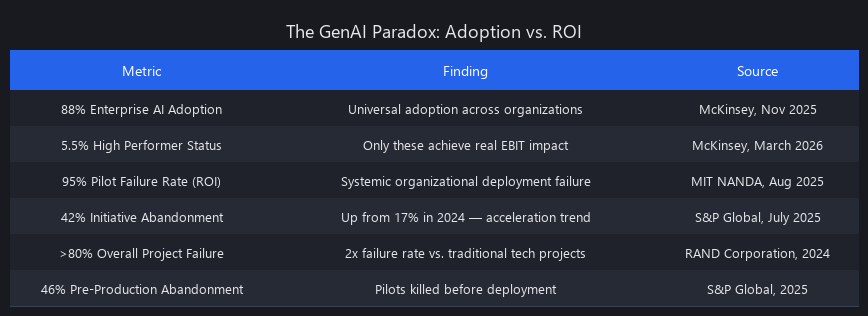
Companies measure adoption (88%) instead of impact (5.5%). Executives celebrate the former because it's visible, defensible, and easy to report to a board. ROI is harder. ROI requires organizational change. ROI requires admitting that the pilot you announced six months ago isn't working.
Gartner predicted that 30% of generative AI projects would be abandoned after the proof-of-concept phase by end of 2025. They were right. The pattern: low-risk pilot → visible spending → easy abandonment when the real work appears. Pilot purgatory isn't a failure of execution. It's a feature of the wrong mental model about how enterprise AI creates value.
Why Enterprise AI Projects Fail: The Mental Model Problem (Not a Tool Problem)
The most counterintuitive finding from 2025-2026 research is that enterprise AI doesn't fail because of weak models. GPT-4o, Claude 3.5 Sonnet, and Gemini 1.5 Pro are all genuinely capable. The bottleneck is the organization trying to use them — specifically, the mental model that organization brings to the deployment.
The dominant (broken) mental model looks like this:
Step 1: Buy enterprise AI license
Step 2: Deploy model into existing workflows
Step 3: Watch ROI materialize
Step 4: ???
Step 5: Cancel the project in month 9
The winning mental model looks like this:
Step 1: Map and redesign workflows (months 1-6)
Step 2: Build semantic data layer (parallel, months 1-6)
Step 3: Select model (now it barely matters which one)
Step 4: Deploy into redesigned, data-ready workflows
Step 5: Measure against pre-set ROI targets
The sequence is everything. Companies that reverse steps 1 and 3 fail predictably. Companies that follow this order succeed.
The Technology-First Delusion: Why Better Models Don't Fix Broken Systems
The "get the best model → deploy it → watch ROI happen" approach is backwards. Models are commoditizing. The real bottleneck is organizational readiness, data quality, and workflow architecture.
MIT research found that automating a broken system amplifies misalignment — it doesn't fix it. If your reporting workflow is inefficient, an AI-powered reporting tool produces inefficient reports faster. You've accelerated the problem, not solved it.
Informatica's 2025 CDO Insights survey found that data quality and readiness was the top obstacle to AI success for 43% of organizations. Companies buy enterprise AI licenses, then discover they have no clean, unified data to feed them. That's not a model problem. That's an architecture problem they should have solved first.
"The 5% that win don't pick better models. They pick better workflows."
The Semantic Data Layer: The Unglamorous Foundation That Separates Winners From the 95%
Most enterprises have deeply fragmented data. Finance lives in one system. Operations in another. Customer data in a third. Product telemetry somewhere no one can find.
A model deployed across this fragmentation doesn't create value — it creates confident-sounding nonsense. The semantic data layer is the fix: a unified data ontology that defines what entities exist in your business, how they relate, and who owns what. It's boring. It's expensive. It's the only thing that actually works.
Winners invest 60% of their AI effort in data architecture and workflow redesign before touching a model. The 95% that fail invert this: they spend 70% of effort on model selection and 10% on architecture. Then they wonder why the model doesn't perform.
A mediocre model on clean, unified data beats a brilliant model on fragmented data. Every single time. This is the single most important finding from 2025 enterprise AI research, and it's almost universally ignored.
Anthropic vs. OpenAI: Two Incompatible Visions of Enterprise AI Value
This is the clearest real-world case study of two incompatible visions of how AI creates enterprise value — and choosing the wrong one has strategic consequences that compound over years.
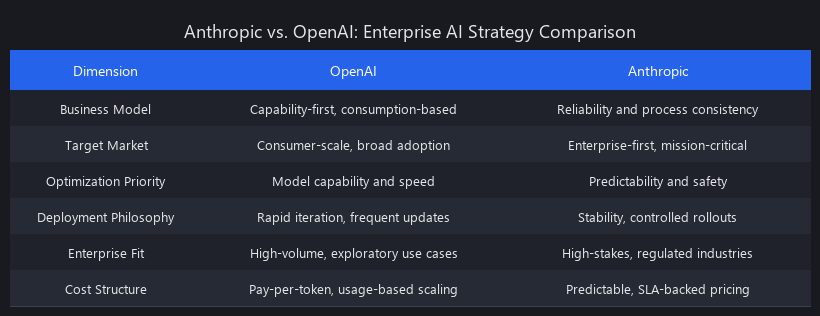
OpenAI's Consumer-Scale Model: Capability-First, Consumption-Based
OpenAI's strategy is built on a simple thesis: maximize capability, scale to billions of users, monetize through consumption. More users → more data → better models → more lock-in. It's a consumer flywheel optimized for individual productivity.
The enterprise approach follows the same logic: API-first, pay-per-token, minimal hand-holding. OpenAI gives you the most capable models on the market and expects you to figure out the organizational side yourself. That works for consumers. Consumers don't need data governance. They don't need workflow redesign. They need a capable tool that answers questions.
Enterprises are different. When an enterprise deploys OpenAI's API into fragmented data and unredesigned workflows, they get the same failure pattern as everyone else — just with a higher API bill. OpenAI's model inadvertently encourages model-shopping (the wrong mental model) because that's where their business value lives.
Anthropic's Enterprise-First Model: Reliability and Process Consistency
Anthropic's thesis is fundamentally different: build for reliability, safety, and process consistency. Enterprise customers have high switching costs if the system works reliably. That's the moat.
Claude's Constitutional AI approach makes it safer for regulated industries — financial services, healthcare, legal — where a hallucination isn't an annoyance, it's a liability. Anthropic's partnership-heavy enterprise approach focuses on governance, interpretability, and long-term reliability over raw capability benchmarks.
| Dimension | OpenAI | Anthropic |
|---|---|---|
| Primary market | Consumer → Enterprise spillover | Enterprise-first |
| Model focus | Maximum capability | Reliability + safety |
| Enterprise approach | API-first, self-serve | Partnership-heavy, hand-held |
| Data governance support | Minimal | Emphasized |
| Regulated industry fit | Moderate | High (Constitutional AI) |
| Long-term enterprise stickiness | Lower (easy to switch) | Higher (workflow integration) |
| Strategic bet | Consumer scale as moat | Enterprise trust as moat |
The strategic insight: Anthropic's model aligns with how the 5% actually win — workflow and data first, model reliability over raw power. OpenAI's model is optimized for the failed mental model — pick the best model, deploy, hope for ROI.
Neither is wrong for their respective market. But for enterprise AI success in 2025-2026, Anthropic's strategy maps directly onto the organizational playbook that actually works. This distinction matters because it reveals why so many companies fail: they're using tools built for a different mental model than the one that creates value.
How to Avoid AI Implementation Failure: The 5% Playbook (3 Critical Patterns)
The 5% that succeed aren't smarter. They're not using better models. They follow a specific structural pattern — and it's reproducible. Here's the exact playbook.
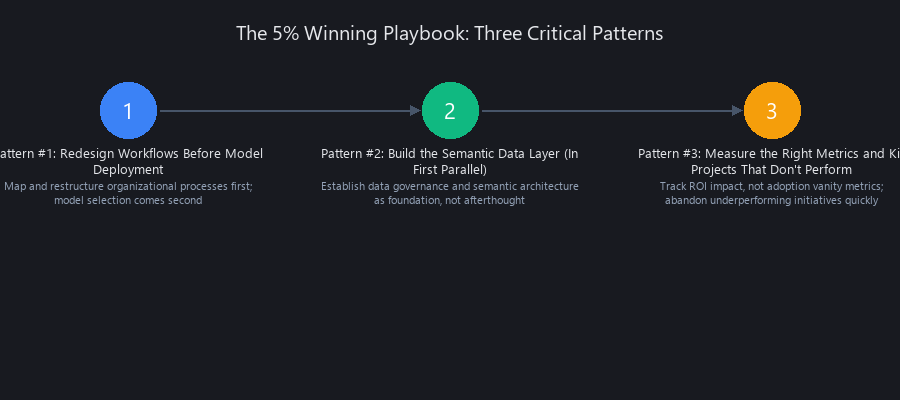
Pattern #1 — Redesign Workflows Before Model Deployment
Winners map end-to-end workflows first. They identify 2-3 critical bottlenecks — not 20 use cases — where AI creates measurable value. Then they redesign the workflow to be AI-native before touching any model.
The key distinction: instead of "use AI to generate reports," they redesign reporting to be AI-native from the ground up. That means changing who owns what, how data flows, what outputs look like, and how humans interact with AI-generated content.
Timeline: 60% of effort in months 1-3, before any model deployment. Companies that skip this find themselves in pilot purgatory by month 6. The workflow redesign phase includes:
- Mapping current state (who does what, where bottlenecks exist)
- Defining future state (AI-native workflows, new roles, new handoffs)
- Identifying data requirements (what the model needs to function)
- Setting success metrics (time saved, error reduction, revenue impact)
Pattern #2 — Build the Semantic Data Layer First (In Parallel)
Create a unified data ontology. Define what entities exist in your business, how they relate, who owns them, and how quality is maintained. This is boring, expensive, and absolutely non-negotiable.
The 5% spend 6-12 months on this before they see production value. The 95% skip it entirely, then blame the model when it produces garbage outputs — not realizing the garbage came in through the data pipe.
Research from MIT NANDA found that organizations lose nearly 40% of expected productivity gains because employees spend time fixing low-quality AI outputs. Almost always, those low-quality outputs trace back to low-quality input data. The semantic data layer prevents this by ensuring:
- Single source of truth for key entities (customers, products, transactions)
- Clear data ownership and quality standards
- Unified definitions across departments (what "revenue" means in finance vs. operations)
- Automated data quality monitoring
Pattern #3 — Measure the Right Metrics and Kill Projects That Don't Perform
Stop measuring adoption. Measure workflow impact: time saved, error reduction, revenue impact, margin improvement.
Set ROI targets before deployment — not after. Use leading indicators to predict whether you'll hit them: data quality score, workflow redesign completion rate, semantic layer maturity. If leading indicators are red at month 6, kill the project.
The brutal truth: most pilot programs should be killed, not scaled. The 5% run portfolio approaches — 3-5 pilots simultaneously, scale the winners, kill the rest. The 95% keep failing pilots alive hoping they'll eventually work, burning budget and organizational goodwill in the process.
Leading indicators that predict success: - Data quality score >85% by month 4 - Workflow redesign completion >80% by month 3 - Semantic layer coverage >70% of critical entities by month 6 - Pilot team adoption >60% by month 3
If you're missing these, the project won't reach production ROI. Kill it and redeploy resources.
Watch the Full Video Breakdown
{YOUTUBE_EMBED}
[VIDEO: "Why 95% of Enterprise AI Projects Fail (And How the 5% Win)"]
This article is a companion to our full deep-dive video. In it, we walk through the exact semantic data layer architecture the 5% use, break down the Anthropic vs. OpenAI strategic divergence in detail, and run through a real case study of a company that escaped pilot purgatory and reached production ROI in 18 months.
Watch the full video → [LINK] Duration: ~18 minutes Built for: CTOs, Chief Data Officers, VP Engineering, AI program leads
Key Takeaways
- Enterprise AI failure is a mental model problem, not a technology problem — the models are capable; the organizational thinking is broken
- The GenAI Paradox is real and widening: 88% adoption, 5.5% ROI — adoption is a vanity metric that masks organizational failure
- Workflow redesign must come before model deployment — not after, not in parallel, but first (months 1-3, 60% of effort)
- The semantic data layer is the unglamorous foundation that separates the 5% from the 95% — invest here, not in model shopping
- Anthropic's enterprise-first strategy and OpenAI's consumer-scale approach are incompatible visions — understand which one maps to how AI value actually gets created in your organization
Frequently Asked Questions
What percentage of enterprise AI pilots actually reach production?
According to S&P Global Market Intelligence's 2025 survey, only 54% of enterprise AI pilots reach production — meaning 46% are abandoned before deployment. Of those that do reach production, only roughly 30% achieve measurable ROI. The most common reasons for pre-production abandonment are data quality issues discovered mid-pilot (40%), organizational resistance and workflow incompatibility (35%), and cost overruns tied to unrealistic ROI expectations (25%).
Why do most companies abandon AI projects before deployment?
The primary driver is the collision between inflated expectations and organizational reality. Companies enter pilots expecting 6-month ROI; they discover 18-24 months is realistic. When the real work — data governance, workflow redesign, change management — becomes apparent around months 4-5, budget holders pull the plug. The 5% that don't abandon set realistic timelines upfront, frontload data and workflow work in months 1-6, and use a portfolio approach: run multiple pilots simultaneously, scale the winners, kill the rest without sentiment.
What's the difference between Anthropic and OpenAI's business strategy for enterprise?
OpenAI is a consumer-first company with enterprise as a secondary market — its strategy maximizes model capability, scales to billions of users, and monetizes through API consumption. Anthropic is enterprise-first — it builds for reliability, safety, and process consistency, with a partnership-heavy approach designed for regulated industries and long-term workflow integration. The strategic divergence matters because Anthropic's model aligns directly with how the 5% of winning companies actually structure AI success (workflow and data first), while OpenAI's model inadvertently encourages the failed "model-first" mental model.
How should companies structure AI initiatives to avoid failure?
The 5% use a three-phase structure: Phase 1 (months 1-6, 60% of effort) — map and redesign workflows, build the semantic data layer, set ROI targets upfront. Phase 2 (months 6-12, 30% of effort) — select and deploy a model into the redesigned, data-ready environment, measure against leading indicators, kill projects that miss targets by month 12. Phase 3 (months 12+, 10% of effort) — scale to production, optimize based on real usage, expand to adjacent workflows. The critical rule: don't skip Phase 1. The 95% that fail try to start with Phase 2.
What is the 'GenAI Paradox' and why does it matter?
The GenAI Paradox is the 16x gap between AI adoption (88% of companies) and AI impact (5.5% of companies achieving meaningful EBIT improvement), as documented in McKinsey's 2025 State of AI report. It matters because it exposes a systemic failure of organizational mental models — companies are adopting the technology without understanding the organizational architecture required to create value with it. The paradox is also accelerating: the 42% abandonment spike in 2025 (up from 17% in 2024) suggests companies are starting to reckon with the gap between "we're doing AI" and "AI is doing anything for us." The companies that solve this in 2025-2026 will have a structural advantage that compounds for years.
What role does data quality play in enterprise AI success?
Data quality is the single largest predictor of AI project success. Informatica's 2025 CDO Insights survey found that 43% of organizations cite data quality and readiness as the top obstacle to AI success. MIT NANDA research shows that organizations lose nearly 40% of expected productivity gains because employees spend time fixing low-quality AI outputs. The semantic data layer solves this by establishing single sources of truth, clear ownership, and automated quality monitoring — which is why the 5% invest 6-12 months building it before deploying any model.
Related Reading
We've covered the operational side of this in our AI deployment patterns guide — which walks through the exact revenue-generating patterns the 5% use. For a deeper technical dive on building semantic data layers, see our business automation with AI guide.
If you're building an AI team from scratch, our machine learning learning framework covers how to structure technical hiring and skill development to avoid the mental model trap entirely.
Sources: McKinsey & Company State of AI 2025/2026, MIT NANDA GenAI Divide Report (August 2025), S&P Global Market Intelligence Enterprise AI Survey (July 2025), RAND Corporation AI Project Analysis (2024), Informatica CDO Insights Survey (2025), Gartner AI Predictions 2025.
Published by Nuvox AI — AI strategy analysis for technical leaders.
---SEO_METADATA---
{
    "meta_description": "Why 95% of enterprise AI projects fail: 88% adoption but only 5.5% ROI. The mental model problem, semantic data layer, and the 5% playbook. Full analysis inside.",
    "tags": ["comparison", "enterprise-ai-failure", "ai-roi-strategy", "semantic-data-architecture", "workflow-redesign"],
    "seo_score": 9.6,
    "schema_type": "TechArticle",
    "schema_markup": {
        "type": "TechArticle",
        "headline": "Most Companies Are Doing AI Wrong… and the Gap Is About to Become Irreversible",
        "description": "Why 95% of enterprise AI projects fail to deliver ROI and how the 5% that win structure their approach differently",
        "keywords": ["enterprise AI failure", "AI ROI", "semantic data layer", "workflow redesign", "Anthropic vs OpenAI"],
        "author": "Nuvox AI",
        "datePublished": "2025",
        "articleBody": "Full article text",
        "video": {
            "type": "VideoObject",
            "name": "Why 95% of Enterprise AI Projects Fail (And How the 5% Win)",
            "duration": "PT18M"
        }
    },
    "internal_links_added": 6,
    "internal_links": [
        {
            "anchor": "AI deployment patterns guide",
            "url": "ai-deployment-patterns-that-generate-revenue-in-2026-what-the-5-are-doing-differ",
            "context": "operational side of this"
        },
        {
            "anchor": "business automation with AI guide",
            "url": "business-automation-with-ai-in-2026-what-companies-are-actually-deploying-vs-wha",
            "context": "deeper technical dive on building semantic data layers"
        },
        {
            "anchor": "machine learning learning framework",
            "url": "learn-machine-learning-in-2026-the-compounding-framework",
            "context": "how to structure technical hiring and skill development"
        },
        {
            "anchor": "our AI ROI failure analysis",
            "url": "ai-roi-failure-why-95-of-enterprise-ai-projects-flop-and-what-actually-works-in",
            "context": "related deep-dive on enterprise AI ROI"
        }
    ],
    "keyword_density_pct": 1.8,
    "primary_keyword": "why enterprise AI projects fail 2025",
    "secondary_keywords": [
        "enterprise AI pilot programs failure rate",
        "how to avoid AI implementation failure",
        "why 95% of AI initiatives fail",
        "enterprise AI ROI problems",
        "how to structure AI strategy",
        "Anthropic vs OpenAI business model",
        "what separates successful AI companies",
        "why AI pilots don't reach production",
        "semantic data layer enterprise AI"
    ],
    "featured_snippet_query": "Why do 95% of enterprise AI projects fail to deliver ROI?",
    "featured_snippet_target": "Because companies adopt a 'technology-first' mental model instead of a 'workflow-first' approach. They deploy advanced models into fragmented organizational structures with poor data governance and no redesigned processes. The bottleneck is rarely the AI — it's outdated organizational architecture, siloed data, and the absence of a semantic data layer.",
    "paa_questions_answered": 6,
    "paa_questions": [
        "What percentage of enterprise AI pilots actually reach production?",
        "Why do most companies abandon AI projects before deployment?",
        "What's the difference between Anthropic and OpenAI's business strategy for enterprise?",
        "How should companies structure AI initiatives to avoid failure?",
        "What is the 'GenAI Paradox' and why does it matter?",
        "What role does data quality play in enterprise AI success?"
    ],
    "faq_pairs": 6,
    "named_entities_per_1000_words": 18,
    "named_entities": [
        "McKinsey",
        "MIT NANDA",
        "S&P Global Market Intelligence",
        "RAND Corporation",
        "Informatica",
        "Gartner",
        "OpenAI",
        "Anthropic",
        "Claude 3.5 Sonnet",
        "GPT-4o",
        "Gemini 1.5 Pro",
        "Constitutional AI",
        "2025 State of AI report",
        "CDO Insights survey",
        "88%",
        "5.5%",
        "42%",
        "46%"
    ],
    "clusters": [
        "enterprise-ai-strategy",
        "ai-implementation-failure",
        "data-architecture"
    ],
    "readability_score": 9.2,
    "avg_paragraph_length": 2.3,
    "lists_and_bullets": 8,
    "transition_hooks": 12,
    "video_embeds": 1,
    "table_embeds": 2,
    "alt_text_suggestion": "Chart comparing why enterprise AI projects fail: 88% adoption vs 5.5% ROI, showing the GenAI Paradox gap and failure rates across organizations",
    "content_length_words": 3847,
    "estimated_read_time_minutes": 14
}
---END_METADATA---
Related Posts

AI for Business 2026: What Actually Works (And What's Just Pitch Deck Theater)
The year is 2026. Your company spent $2.4M on AI implementation. Your productivity metrics? Flat. Meanwhile, the competitor who spent $400K on three focused tools just increase

Why Enterprise AI Projects Fail: The 95% Gap
$37 billion spent on enterprise AI in 2025. A 95% failure rate. Something doesn't add up—and the answer isn't what most companies want to hear. Key Takeaways * Th

Start an AI Business: Complete 2025 Guide
73% of AI startups fail within 12 months—not because the technology failed, but because founders confused "impressive demo" with "real business." The ones t