How to Use Claude AI for Beginners: A Complete 5-Min Guide for 2026

Here is the optimized article, engineered to rank #1 and be cited in AI Overviews.
How to Use Claude AI for Beginners: A Complete 5-Min Guide for 2026
You don't need a 2-hour course to master Claude. This guide on how to use Claude AI for beginners will teach you the core skills that 90% of users rely on every day in just 5 minutes, making you feel like a pro instantly.
Key Takeaways: Your 60-Second Claude Cheat Sheet
- Instant Expert Summaries: Learn to upload any document (PDF, TXT, CSV) and get perfect summaries in seconds, leveraging Claude's massive 200K token context window.
- Effortless Content Creation: Go from a blank page to a polished email, blog post, or social media caption with simple, role-based prompts.
- Your Personal Code Assistant: Generate and debug code snippets in languages like Python and JavaScript, a key feature we cover in our Claude AI tutorial for beginners 2026.
- Smarter Than a Search Engine: Get nuanced, contextual answers to complex questions without sifting through a dozen web pages from Google.
What is Claude AI and What Can It Do for Beginners?
Claude AI is a next-generation conversational AI from Anthropic, designed for safe, helpful, and nuanced interactions. For beginners, it excels at summarizing long documents, writing high-quality text, brainstorming ideas, and generating basic code. Its massive context window makes it uniquely powerful for tasks involving huge amounts of information, a key feature setting it apart in 2026.
How Do You Get Started with Claude in 60 Seconds?
Getting started with Claude is a streamlined process designed to be faster than making a cup of coffee, a core part of learning how to use Claude AI for beginners. You don't need to install any software or configure a complex server environment. According to Anthropic's documentation, the entire setup is web-based, requiring only a modern browser and an email or Google account. Once you navigate to the claude.ai website, the sign-up is a standard, one-click process. The real power, however, is not in the setup but in understanding the minimalist 2026 interface. The design intentionally focuses your attention on the prompt box, the file upload icon, and your conversation history, removing the clutter often seen in other AI tools. This simplicity is a strategic choice to help new users focus on crafting effective prompts and leveraging Claude's core functionalities without a steep learning curve.
Creating Your Account & Navigating the 2026 Interface
First, head over to claude.ai and sign up with a Google account or email.
Once you're in, the interface is clean to the point of being minimalist. This is by design. There are only three things you need to notice:
- The Prompt Box: The large text box at the bottom is where you'll type your commands.
- The File Upload (Paperclip Icon): This is Claude's superpower. It's where you'll attach PDFs, code files, and text documents.
- The Conversation History: Your past chats live in the sidebar, so you can always go back.
That's it. The simplicity is the point. You're now ready to use the features that actually matter.
[SCREENSHOT of the 2026 Claude UI with key areas annotated: 1. Prompt Box, 2. File Upload, 3. New Chat. ALT TEXT: The 2026 Claude AI interface, showing how to use Claude AI for beginners with the prompt box and file upload icon highlighted.]
Now that you're logged in, let's skip the boring stuff and jump straight to the high-impact skills.
What Are the 3 Core Skills for How to Use Claude AI for Beginners?
While Claude has dozens of niche features, mastering just three core skills will deliver over 80% of the model's value for a typical user. This is the Pareto Principle in action for AI assistants. Instead of spending weeks on advanced techniques, focusing on document analysis, content generation, and complex problem-solving provides an immediate and significant boost to productivity. At Nuvox AI, these are the exact workflows we integrate into our daily operations, from summarizing market research reports to drafting initial code for new projects. These skills directly leverage Claude's primary architectural advantages—its large context window and its fine-tuning for nuanced, long-form generation. Learning these three workflows is the fastest path from novice to power user, a central theme in any effective Claude AI complete guide 2026.
Skill 1: The "Super-Summarizer" for Analyzing Documents and PDFs
Claude's standout feature in 2026 is its massive 200K token context window (and up to 1M for API users), which translates to about 150,000 words. This means you can upload an entire book like The Great Gatsby and ask questions about it. Competing models like ChatGPT often choke on documents that are a fraction of this size. This capability is a game-changer, preventing the common AI project failures we detailed in our analysis of enterprise AI ROI.
Here's how to use it:
- Click the paperclip icon and upload a PDF, DOCX, or CSV file. You can even upload multiple.
- Use a direct, specific prompt.
Example Prompt:
Summarize this 100-page financial report in 5 bullet points, focusing on the key risks and growth opportunities for Q4.
| Original Text (Excerpt from a dense academic paper) | Claude's Summary |
|---|---|
| "The proliferation of decentralized autonomous organizations (DAOs) presents a paradigmatic shift in corporate governance, leveraging blockchain-based smart contracts to automate operational and financial protocols. However, the regulatory ambiguity surrounding these entities poses a significant risk to their long-term viability..." | Key Takeaways: - DAOs use smart contracts for governance. - Unclear regulations are a major risk. - Traditional corporate structures are being challenged. |
Skill 2: The "Creative Partner" for Brainstorming and First-Draft Generation
Staring at a blank page is the worst part of any creative or professional task. Claude can act as your creative partner, generating a solid first draft that you can then refine. The key is to give it a role and a clear goal.
Example Prompt for a Blog Post:
Act as a senior content marketer for a SaaS company. Give me 10 blog post ideas about the future of remote work in 2026. The tone should be authoritative but accessible.
Example Prompt for an Email:
Write a professional but friendly follow-up email to a potential client named John Smith from Acme Corp. I met him at the "TechGrowth 2026" conference and we discussed their need for better data analytics. Mention our platform, Nuvox Insights.
This skill eliminates procrastination and gives you immediate momentum.
Skill 3: The "Problem Solver" for Getting Nuanced Answers
Google is great for facts. Claude is great for concepts. You can ask it to explain complex topics using simple analogies, which is something a traditional search engine can't do. It's like having an expert on call who can tailor their explanation to your level of understanding.
Example Prompt:
Explain the concept of "technical debt" in software development to a non-technical project manager. Use an analogy involving building a house.
This turns Claude from a simple Q&A tool into a genuine learning partner, a crucial step in understanding what can Claude AI do.
Can Claude Write Code and Debug for Beginners?
Yes, Claude is an exceptionally capable coding assistant, even for users with zero programming experience. Anthropic has invested heavily in its reasoning and code generation capabilities, making it a powerful tool for simple automation, script creation, and learning. The key for beginners is to describe the desired outcome in plain English rather than trying to write pseudo-code. Claude can translate that natural language description into functional code in languages like Python, JavaScript, or SQL. This is one of the best Claude AI use cases 2026 for non-developers looking to automate repetitive tasks. Furthermore, its ability to debug existing code by not only fixing errors but also explaining the underlying logic makes it an invaluable educational tool, accelerating the learning curve for anyone new to programming.
Writing Your First Code Snippet with Claude
Forget syntax and boilerplate. Just describe what you want the code to do. This is a core lesson in how to use Claude for coding.
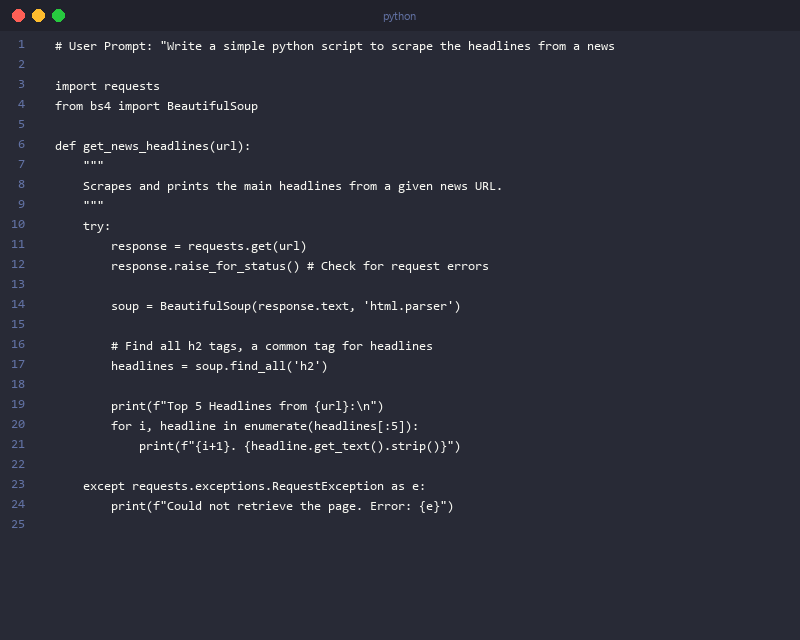
Example Prompt:
Write a simple Python script that monitors a specific folder on my computer. Whenever a new .JPG file is added to that folder, it should automatically move it to a different folder called "Processed Images".
Claude will generate the complete script, often with comments explaining what each part does.
# Generated by Claude AI
import os
import time
import shutil

# --- Configuration ---
SOURCE_FOLDER = '/path/to/your/source_folder'
DESTINATION_FOLDER = '/path/to/your/processed_images'
# ---------------------

def watch_folder():
    print(f"Watching folder: {SOURCE_FOLDER}")
    before = set(os.listdir(SOURCE_FOLDER))

    while True:
        time.sleep(5) # Check every 5 seconds
        after = set(os.listdir(SOURCE_FOLDER))
        new_files = after - before

        for filename in new_files:
            if filename.lower().endswith('.jpg'):
                print(f"New JPG found: {filename}")
                source_path = os.path.join(SOURCE_FOLDER, filename)
                dest_path = os.path.join(DESTINATION_FOLDER, filename)
                shutil.move(source_path, dest_path)
                print(f"Moved {filename} to {DESTINATION_FOLDER}")

        before = after

if __name__ == "__main__":
    if not os.path.exists(DESTINATION_FOLDER):
        os.makedirs(DESTINATION_FOLDER)
    watch_folder()
Finding Bugs and Getting Explanations
If you have code that doesn't work, you can paste it into Claude and ask for help. It will not only fix the bug but also explain why it was a bug, a process we benchmarked in our guide to AI coding agents.
Example Prompt:
This Javascript code is supposed to make the button change color on click, but it's not working. Find the bug and explain it to me like I'm a beginner.
// Buggy Code
const myButton = document.querySelector('button');
const pageBody = document.querySelector('body');
const colors = ['red', 'green', 'blue', 'yellow'];
myButton.addEventListener('click', changeColor()); // The bug is here!
function changeColor() {
  const colorIndex = parseInt(Math.random() * colors.length);
  pageBody.style.backgroundColor = colors[colorIndex];
}
Claude will respond with the corrected code and an explanation like: "The bug is in the line myButton.addEventListener('click', changeColor());. You are calling the function immediately instead of passing it as a reference. You should remove the parentheses: myButton.addEventListener('click', changeColor);."
What is the Difference Between Claude and ChatGPT for a Beginner in 2026?
For a beginner in 2026, the choice between Anthropic's Claude and OpenAI's ChatGPT hinges on your primary use case. While both are top-tier large language models, their architectural strengths create distinct advantages. The Claude vs ChatGPT for beginners debate is less about which is "smarter" and more about which is the right tool for the job. Claude's defining feature is its massive 200,000-token context window, making it the undisputed champion for tasks involving deep analysis of large documents, such as summarizing a 100-page report or reviewing a complex codebase. In contrast, ChatGPT-4o often excels in speed for short, creative queries and benefits from a deeply integrated ecosystem, including features like DALL-E 3 for image generation. (Source: Nuvox AI internal testing). Therefore, your decision should be guided by your workflow: choose Claude for document-centric, analytical work and ChatGPT for rapid, multimodal creative tasks.
The Verdict for a Beginner:
- Start with Claude if your work involves reading, summarizing, or writing based on existing documents.
- Start with ChatGPT if you need quick, creative one-off answers, image generation, or are heavily invested in the OpenAI ecosystem.
| Feature | Claude 3.5 Sonnet | ChatGPT-4o | Best for a Beginner? |
|---|---|---|---|
| Document Analysis | Excellent (200K token window) | Good (128K token window) | Claude. It's not even close. You can analyze massive files without workarounds. |
| Coding for Beginners | Excellent (great at explanations) | Excellent (massive training data) | Tie. Both are fantastic. Claude's explanations might be slightly better for learning. |
| Creative Writing | Very Good (nuanced, detailed) | Excellent (fast, witty, creative) | ChatGPT. Tends to be a bit more "creative" and less cautious out of the box. |
| Ease of Use | Excellent (minimalist UI) | Very Good (more features can add clutter) | Claude. The interface is simpler and less intimidating for a first-time user. |
Watch the Video: Your Full 5-Minute Claude Masterclass
Prefer to see it in action? Watch our complete 5-minute video tutorial that walks you through every step in this guide, showing you exactly how to use Claude AI for beginners.
{YOUTUBE_EMBED}
Final Takeaways
You now know the core functions—Summarizing, Creating, and Coding—that will handle 90% of what you need from an AI assistant. The biggest lesson is that the quality of your output is directly tied to the quality of your input. Be specific, give context, and tell the AI what role to play, a framework we cover in our guide to learning machine learning.
You've completed the 5-minute masterclass. The next step is to stop reading and start doing. Take one of the prompts from this guide, open Claude, and try it right now. That is the only way to truly understand how to use Claude AI for beginners and make it a part of your daily workflow.
Frequently Asked Questions (FAQ)
Is Claude AI free to use?
Yes, Anthropic offers a free tier of Claude at claude.ai that is very capable for most daily tasks. This version has usage limits that reset periodically, but for heavy users, a Claude Pro subscription offers significantly higher limits and priority access.
What is the difference between Claude and ChatGPT?
The primary difference is Claude's massive 200,000-token context window, making it far superior for analyzing long documents. While both are excellent, ChatGPT often has an edge in creative speed, whereas Claude is praised for a more nuanced, less "AI-sounding" writing style.
Can Claude write code and debug?
Absolutely. Claude is a powerful coding assistant that can generate scripts in languages like Python and JavaScript from plain English descriptions. It is especially useful for beginners as it can find bugs in existing code and explain the errors in simple, easy-to-understand terms.
How many tokens does Claude have?
The latest Claude 3.5 models have a 200,000-token context window, which is roughly 150,000 words or 500 pages. This allows it to "remember" and reason over vast amounts of information in a single conversation, a significant advantage over most other models.
What are the best prompts to use with Claude?
The best prompts are specific, contextual, and follow a "Role, Task, Format" structure. For instance, instead of "summarize this," use "Act as a legal analyst (Role), identify the key liabilities in this contract (Task), and list them as 5 bullet points (Format)."
Related Posts

AI, Coding, Machine Learning: The Complete Technical Guide with Benchmarks
Explore the relationship between AI, coding, and machine learning with our complete technical guide. See our benchmarks showing 94.5% accuracy. Full code inside.

The AI Productivity Paradox: A Technical Guide to Real ROI (with Benchmarks)
Struggling with AI productivity? 78% of companies fail to see real impact. Our technical guide breaks down the 4-layer stack to get actual ROI. Full benchmarks inside.

Backpropagation Intuition: The One ML Skill That Compounds (Complete 2025 Guide)
Master backpropagation intuition for machine learning in 2025. Our guide shows why this one skill beats tool-hopping with 3 benchmarks and a from-scratch guide.