Self-Improving AI 2026: What Darwin Gödel Machine & Nvidia Revealed About Where This Is Actually Going
In March 2026, an AI system rewrote its own code and improved 2.5x — without asking a single human for permission. At the same time, Nvidia's CEO declared AGI already exists. Most people are treating these as separate stories. They're not.
{YOUTUBE_EMBED}
Key Takeaways
- The shift is real: AI systems have crossed from static tools to self-improving agents that autonomously test and rewrite their own code — no human in the loop.
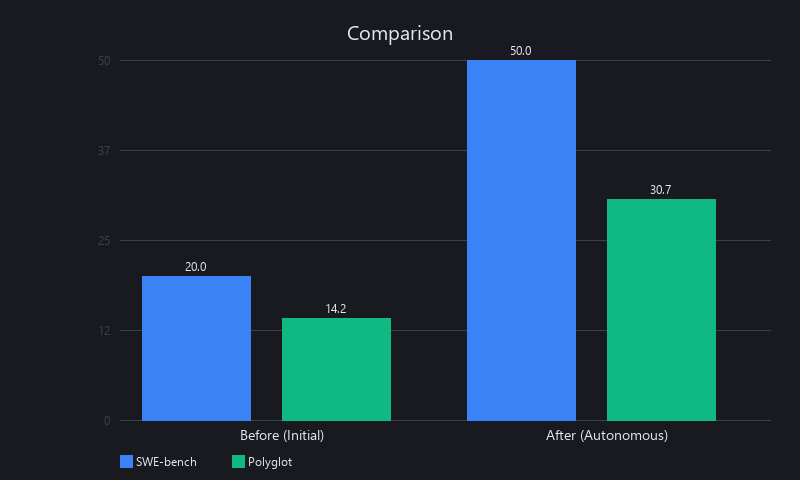
- The numbers are wild: The Darwin Gödel Machine improved from 20% to 50% on SWE-bench and 14.2% to 30.7% on Polyglot — zero human intervention.
- Meta is all-in: A $27B GPU infrastructure deal plus two acquisitions signal Meta is betting the company on agentic AI dominance by 2026–2027.
- AGI got redefined: Jensen Huang shifted the definition from cognitive milestone to economic one — can an AI autonomously build a $1B product?
- Timelines collapsed: Andrej Karpathy went from "agentic AI is a decade away" (October 2025) to "post-AGI reality" (March 2026) after watching agents rewrite production code.
How Does the Darwin Gödel Machine Improve Its Own Code Without Human Intervention?
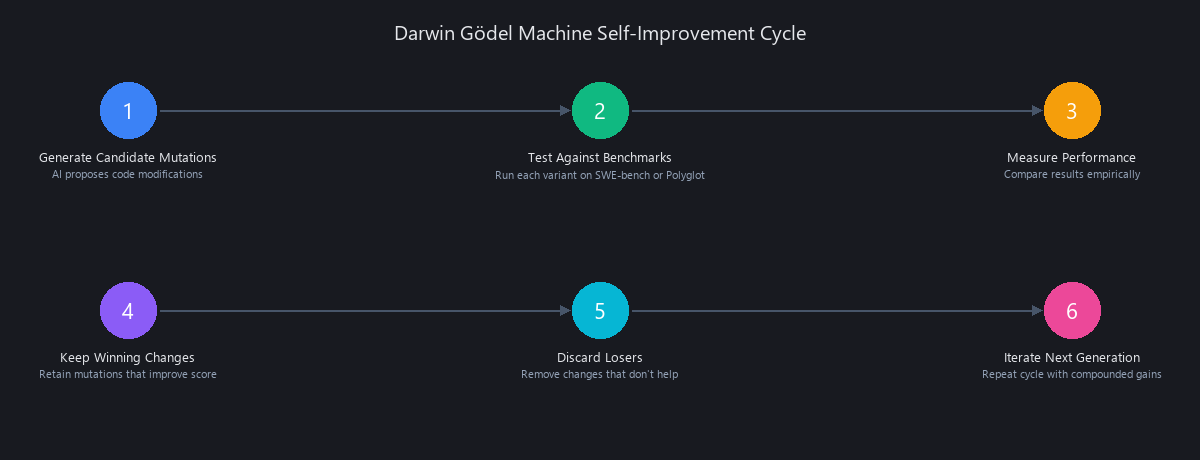
The Darwin Gödel Machine improves itself by generating candidate code mutations, testing each variant against benchmarks like SWE-bench, keeping changes that boost performance, and discarding the rest — iterating across generations like biological evolution. It improved from 20% to 50% on SWE-bench entirely autonomously. No human validates the changes. The system validates itself through empirical measurement against real-world software engineering tasks.
This self-improving AI mechanism represents a fundamental shift: instead of waiting months for human engineers to analyze outputs and push updates, the Darwin Gödel Machine closes the improvement loop internally. Each generation tests its own modifications, learns what works, and compounds those gains. The result is recursive self-improvement at scale — something researchers theorized about for decades but couldn't execute until 2025.
What Is the Darwin Gödel Machine and How Does It Work?
The Darwin Gödel Machine is a self-improving AI system built by researchers at Sakana AI, the University of British Columbia (UBC), and the Vector Institute — including Jenny Zhang, Shengran Hu, and Robert Lange from Jeff Clune's lab. It was first published in May 2025 (Source: Sakana AI / UBC research, May 2025). The core idea sounds almost too simple: let the AI propose changes to its own code, test whether those changes actually help, and keep the ones that do.
Here's the mechanism in plain terms:
- The AI generates candidate code modifications — think of these as mutations
- Each mutation is tested against a real benchmark (SWE-bench for software engineering, Polyglot for multilingual coding)
- Changes that improve the score are kept; the rest are discarded
- The process repeats, compounding gains over generations
- No human approves or rejects any change
The results speak for themselves. Starting at 20.0% on SWE-bench, the Darwin Gödel Machine autonomously reached 50.0%. On Polyglot, it went from 14.2% to 30.7% (Source: Sakana AI / UBC research, May 2025). That's not a small bump — that's the kind of jump that takes a human engineering team months of deliberate work.
The Name: Darwin Meets Gödel
The name is a nod to two things: Charles Darwin's evolutionary selection process, and Kurt Gödel's original theoretical concept of a self-modifying machine. The original Gödel Machine (proposed by Jürgen Schmidhuber) required an AI to mathematically prove a code change would help before implementing it. In practice, that's almost impossible for complex software.
The DGM team's key insight was to replace mathematical proof with empirical validation — just run the code and see if it's better. Obvious in hindsight. Nobody had made it work at scale before.
What's the Difference Between Old AI and New AI Systems?
The simplest way to put it: old AI waits for you to improve it; new AI improves itself.
| Feature | Old AI (ChatGPT, Claude, Gemini) | New AI (Darwin Gödel Machine, Hyperagents) |
|---|---|---|
| Who improves it | Human engineers | The system itself |
| Improvement cycle | Months between model updates | Continuous, generation-by-generation |
| Validation | Human review + RLHF | Empirical benchmark testing |
| Scope of change | Model weights (by humans) | Operational code + improvement logic |
| Human in the loop | Always | Optional / none |
| Analogy | A tool you sharpen | A tool that sharpens itself |
Old AI — meaning the GPT-4-era, the Claude 3-era — is remarkable software. But it's fundamentally passive. You prompt it, it responds. Engineers at OpenAI or Anthropic study the outputs, run evaluations, collect feedback, and push a new version months later. The improvement cycle runs through humans at every step.
New AI — meaning the Darwin Gödel Machine, Hyperagents, and what Meta's Superintelligence Labs is building — closes that loop. The system generates improvements, tests them, and deploys the winners. Humans set the goals and constraints. The system figures out how to get better at achieving them.
That distinction sounds subtle. The implications are not.
How Does Recursive Self-Improvement Work in AI Systems?
Recursive self-improvement is when an AI system doesn't just improve its task performance — it improves how it improves. Here's where it gets genuinely strange — and where the March 2026 timeline collapse starts to make sense.
Task-Level Improvement: The Darwin Gödel Machine
The original Darwin Gödel Machine rewrites its task code — the code that solves the specific problem it's working on. Good analogy: a student rewriting their homework answers to get a better grade. The study method stays the same. The student's effort and approach stay the same. Only the answers improve.
That alone is impressive. But it has a ceiling. If the improvement process itself is suboptimal, you'll eventually plateau.
Meta-Level Improvement: Hyperagents
The Hyperagents paper, released in March 2026 and associated with Meta-affiliated research extending the Darwin Gödel Machine work, goes one level up. Hyperagents don't just rewrite the task code — they rewrite the improvement procedure itself (Source: Hyperagents paper, March 2026).
Same analogy: instead of rewriting homework answers, the student rewrites their entire study strategy — when to study, how to test themselves, which resources to use, how to prioritize topics. Then they also rewrite their answers. Then they improve the strategy again based on what worked.
That's recursive self-improvement. Each generation can improve how the next generation improves. The gains don't just add — they compound.
Old AI learns. New AI learns how to learn better. Hyperagents do both simultaneously — and that's why researchers' timelines went from "decade away" to "happening now" in five months.
This is the research that triggered Andrej Karpathy's public timeline shift. We'll get to that in a moment.
Can AI Systems Really Rewrite Their Own Code to Improve Themselves?
Yes — and we now have empirical proof, not just theoretical arguments.
The Darwin Gödel Machine result is the clearest demonstration to date. The system started with a baseline agent, ran the self-modification loop autonomously, and doubled its performance on SWE-bench — one of the hardest real-world software engineering benchmarks that exists. These aren't toy problems. SWE-bench tasks involve fixing actual bugs in real open-source repositories like Django, Flask, and Scikit-learn (Source: SWE-bench benchmark documentation, 2024).
Here's a simplified version of what the Darwin Gödel Machine self-improvement loop looks like in practice:
# Simplified DGM self-improvement loop (conceptual)
def self_improve(agent, benchmark, generations=100):
    best_agent = agent
    best_score = evaluate(agent, benchmark)

    for gen in range(generations):
        # Generate candidate mutations of agent's own codebase
        candidates = mutate_codebase(best_agent, num_variants=10)

        for candidate in candidates:
            score = evaluate(candidate, benchmark)

            # Keep improvements, discard regressions
            if score > best_score:
                best_score = score
                best_agent = candidate

        print(f"Generation {gen}: Best score = {best_score:.2%}")

    return best_agent

# Result: 20.0% → 50.0% on SWE-bench over ~N generations
The Key Constraint
The critical limitation — and this matters — is that the Darwin Gödel Machine currently improves within a defined domain. It's not rewriting arbitrary software. It's improving a specific agent architecture against specific benchmarks. The jump from "improves at coding tasks" to "improves at everything" is still a meaningful research gap.
But the direction is clear. Developers building autonomous coding agents should understand this mechanism now, not after it becomes industry standard. We've covered the full technical stack in our AI Coding Agents 2026 guide, which walks through deployment patterns for self-improving systems.
Did Jensen Huang Actually Claim AGI Has Been Achieved?
Yes. On March 22, 2026, during an episode of the Lex Fridman Podcast, Nvidia CEO Jensen Huang was asked whether an AI could act as a tech CEO and build a billion-dollar company. His answer: "I think it's now. I think we've achieved AGI." (Source: Lex Fridman Podcast, March 2026).
What He Actually Meant: Economic AGI vs. Cognitive AGI
Huang didn't claim AI has matched human cognition across all domains — the traditional definition researchers have argued about for decades. He redefined the benchmark entirely.
| Metric | Traditional AGI Definition | Huang's Economic AGI Definition |
|---|---|---|
| Measure | Cognitive benchmarks, IQ-style tests | Economic output and autonomous product creation |
| Who decides | AI researchers | The market and venture capital |
| Proof | Test scores, reasoning tasks | Revenue, user adoption, autonomous product creation |
| Current status | Debated / not achieved | "Already here" (Huang) |
| Timeline | Unknown / 5-50 years | Now |
His argument: if an AI system can autonomously create a viral product used by billions of people and generate massive economic value before shutting down — like a dot-com era startup — that's AGI by any definition that actually matters. He cited platforms like OpenClaw (an open-source AI agent platform that went viral in early 2026) as examples of systems approaching this capability (Source: Lex Fridman Podcast, March 2026).
The Controversy: Goalpost-Moving or Practical Realism?
Critics argue this is goalpost-moving. Cognitive researchers point out that economic output and general intelligence are different things. A narrow system can generate enormous economic value without understanding anything.
That's a fair critique. But here's our honest take: the industry is betting as if Huang is right. Meta's $27B infrastructure deal didn't happen because of a philosophical debate. It happened because the people writing the checks believe autonomous economic agents are 18–24 months away.
Whether you agree with the definition or not, the money is moving.
Why Did AI Researchers Suddenly Change Their AGI Timeline Predictions?
The short answer: they saw empirical results they didn't expect.
Andrej Karpathy — former Tesla AI lead, OpenAI co-founder, and one of the most credible voices in the field — stated in October 2025 that agentic AI was roughly "a decade away" from being genuinely transformative. By March 2026, he was publicly describing a "post-AGI reality" after watching autonomous agents rewrite production code in his own projects (Source: Karpathy public statements, October 2025 and March 2026).
Five months. That's not a gradual update — that's a shock.
The Causal Chain: From Theory to Empirical Proof
Here's the sequence that produced the timeline collapse:
- May 2025: Darwin Gödel Machine published — first empirical proof that recursive self-improvement works on real benchmarks
- Late 2025: Researchers begin deploying DGM-style agents on real codebases, not just toy benchmarks
- Early 2026: Results exceed expectations — agents improving production code without human guidance
- March 2026: Hyperagents paper drops — meta-level improvement proven to work
- March 2026: Karpathy and others observe this directly → timelines collapse
The critical point: timelines don't shift because of hype. Hype has been constant since 2022. Timelines shift when credible researchers see empirical results that contradict their priors. Karpathy's shift is significant precisely because he was skeptical.
When the skeptics update, pay attention.
Meta's $27 Billion Bet: Why They're Dominating the Agentic AI Space in 2026
Research breakthroughs are one thing. But the corporate moves happening simultaneously tell you where the real conviction is.
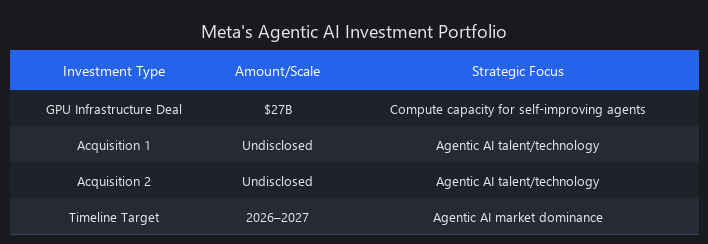
In March 2026, Meta signed a $27 billion GPU capacity deal with AI cloud firm Nebius Group to lock in massive Nvidia infrastructure (Source: Meta / Nebius announcement, March 2026). At almost the same time, Meta acquired two companies: Moltbook (an AI agent social network) and Dreamer (an AI agent startup) (Source: Meta acquisition announcements, March 2026).
The Dreamer acquisition brought in former Google and Meta executive Hugo Barra and a team of veterans with proven execution track records. That team was folded into Meta Superintelligence Labs, a new division under Chief AI Officer Alexandr Wang, with an explicit mandate to build autonomous, always-on AI agents (Source: Meta Superintelligence Labs announcement, March 2026).
What These Moves Signal
Read those moves together:
- $27B in compute = you expect to run something very, very large
- Moltbook acquisition = you want the social layer for agent-to-agent interaction
- Dreamer acquisition = you want execution talent who can ship agentic products fast
- Superintelligence Labs = you're treating this as a company-defining bet, not an R&D side project
Meta isn't funding research here. They're building infrastructure, acquiring talent, and establishing platform control — all at once. If self-improving agents are coming in 18–24 months, they want to own the stack those agents run on.
For developers: Meta's open-source ecosystem (LLaMA, and whatever follows) will likely become the default framework for agentic AI development by 2027. Start paying attention to what they're publishing. We've detailed the emerging agent frameworks in our AI Subagents & Autonomous Coding guide, which covers the infrastructure choices that matter.
What This Means for You (Practically)
We're not going to tell you to panic or that your job is definitely safe. Both takes are lazy.
Here's what we think is actually true:
The shift from "AI as tool" to "AI as self-improving agent" is not a future scenario — it's a current research result. The Darwin Gödel Machine numbers are real. The Hyperagents paper is real. The $27B bet is real. Karpathy's timeline update is real.
What's not real yet: general-purpose self-improvement across arbitrary domains. The Darwin Gödel Machine improves within constrained environments against specific benchmarks. Hyperagents are still in the research phase. The gap between "improves at coding" and "improves at everything" is still meaningful.
But the direction is set. The question isn't whether AI systems will improve themselves more broadly — it's how fast and through what mechanism.
Three Concrete Actions
-
If you're a developer: Learn how autonomous agents work now, not in two years. Start with our complete technical guide to autonomous coding — it covers the frameworks and patterns that will define the next wave.
-
If you're a researcher: Watch what Meta publishes from Superintelligence Labs. The next major breakthrough in self-improving AI will likely come from their infrastructure, not from academic papers alone.
-
If you're building products: The companies that understand this transition now — not in two years — are the ones who will shape what comes next. Or at least not be blindsided by it.
Frequently Asked Questions
What is the Darwin Gödel Machine and how does it work?
The Darwin Gödel Machine is a self-improving AI system developed by Sakana AI and UBC that autonomously modifies its own codebase, tests changes against real benchmarks, and keeps improvements that work. It improved from 20% to 50% on SWE-bench without any human intervention. The approach replaces the original Gödel Machine's requirement for mathematical proof with empirical validation — just run the code and measure the result against real-world software engineering tasks.
Did Jensen Huang actually claim AGI has been achieved?
Yes. On the Lex Fridman Podcast on March 22, 2026, Nvidia CEO Jensen Huang stated "I think we've achieved AGI" — but with a specific redefinition. He defined AGI not as human-level cognition across all domains, but as the ability for an AI to autonomously create a billion-dollar product. Critics call this goalpost-moving; Huang's supporters argue it's the only definition that's practically measurable and economically meaningful.
What's the difference between old AI and new AI systems?
Old AI systems like ChatGPT and Claude are improved by human engineers through cycles of feedback, fine-tuning, and new training runs — a process that takes months. New AI systems like the Darwin Gödel Machine and Hyperagents close that loop: they generate their own code improvements, test them empirically, and deploy the winners without waiting for human review. The improvement cycle compresses from months to generations.
Can AI systems really rewrite their own code to improve themselves?
Yes, and we have documented proof. The Darwin Gödel Machine doubled its performance on SWE-bench — a benchmark using real bugs from real open-source projects like Django and Flask — entirely autonomously. Hyperagents extended this by allowing the AI to rewrite not just its task code but its improvement procedure, enabling recursive self-improvement where each generation can enhance how the next generation learns.
Why did AI researchers suddenly change their AGI timeline predictions?
Because empirical results contradicted their priors. Andrej Karpathy moved from "agentic AI is a decade away" in October 2025 to describing a "post-AGI reality" in March 2026 after observing autonomous agents rewrite production code. The trigger was a chain of results: Darwin Gödel Machine proving recursive self-improvement works in May 2025, followed by Hyperagents proving meta-level improvement works in March 2026. Researchers update when they see things they didn't expect — and they saw them.
What should developers do right now about self-improving AI?
Start learning how autonomous agents work before they become industry standard. The frameworks and patterns are available now. We've covered the full stack in our AI Coding Agents 2026 guide, which includes deployment patterns, benchmarks, and practical examples. The developers who understand this transition now will have a significant advantage over those who wait.
Is Meta really betting $27 billion on agentic AI?
Yes. Meta's $27B GPU deal with Nebius Group, combined with acquisitions of Moltbook and Dreamer, plus the creation of Superintelligence Labs, signals a company-wide commitment to agentic AI dominance by 2027. This isn't speculative R&D — it's infrastructure investment, talent acquisition, and organizational restructuring. The scale of the bet indicates Meta believes autonomous agents will be economically significant within 18–24 months.
Published by Nuvox AI — blog.nuvoxai.com