Learn Coding Right in 2026: The Framework That Actually Compounds

Junior developer job postings dropped 34% year-over-year by March 2026 (Source: LinkedIn). Meanwhile, 5.2 million new developers joined GitHub from India alone in 2025. The problem isn't that coding is dead — it's that how most people learn it became structurally broken almost overnight.
The correct way to learn coding in 2026 is to stop learning syntax and start learning systems thinking. Use AI as a co-pilot for implementation, but build depth in three areas: foundational computer science, system architecture and debugging, and AI orchestration. This approach compounds over 6–12 months and makes you the person who directs AI — not the person AI replaces.
Key Takeaways
- The old model is broken: Syntax memorization and 12-week bootcamps don't produce hireable engineers in 2026 — they produce brittle ones who can't debug AI-generated code
- AI didn't kill coding — it killed the junior copy-paste role: The value shifted from "write code" to "architect systems, debug AI output, orchestrate agents"
- TypeScript + system design are now table stakes: Type safety and architectural thinking compound over time; memorizing
.map()syntax doesn't - The compounding framework works in 3 layers: Foundations → Systems Thinking → AI Orchestration, over 6-12 months — not 12 weeks
- Most learners optimize for the wrong metric: "Projects completed" feels like progress. "Depth of understanding" is what gets you hired
{YOUTUBE_EMBED}
Why Traditional Coding Education Fails in 2026
Traditional bootcamps were engineered for a 2015 job market — high demand, low supply, syntax-heavy work. They optimized for speed over depth, producing engineers who could follow tutorials but couldn't reason about systems. In 2026, that's not a minor gap. It's a career-ending one.
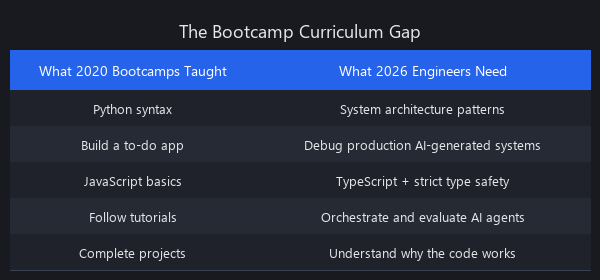
The structural problem is curriculum lag. Most bootcamps still teach React, Python, and SQL the same way they did in 2020. But the job market has moved. By March 2026, GitHub Copilot users were writing 46% of their code with AI (Source: GitHub). When nearly half your codebase comes from a machine, the engineer's job becomes: "Is this correct? Does it fit the architecture? Where's the bug?" That requires deeper understanding, not faster syntax acquisition.
Why AI-Generated Code Breaks More Often Than Human Code
Here's the part nobody talks about. A December 2025 report by CodeRabbit, analyzing 470 open-source pull requests, found that AI-generated code contains 1.7× more issues than human-written code (Source: CodeRabbit, December 2025). Specifically:
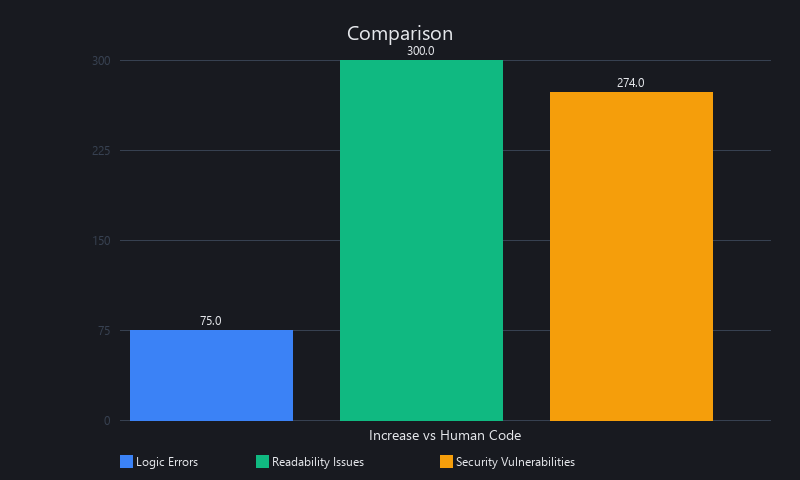
- 75% increase in logic errors
- 300% spike in readability problems
- 2.74× more likely to introduce security vulnerabilities like XSS
So AI writes code faster. And breaks things faster. The engineers who can catch those breaks are worth their salary. The ones who can't are being quietly let go.
Code review times jumped 91% in teams that leaned heavily on AI (Source: CodeRabbit, 2025), because senior engineers spent their hours fixing machine-generated mistakes. That's the new junior developer job — except it requires mid-level judgment.
The Job Market Signal: Where Junior Roles Disappeared
Junior positions made up roughly 40% of software job listings in 2019. By late 2025, that number collapsed to approximately 8% (Source: industry hiring data, 2025). Companies didn't stop hiring engineers — they stopped hiring engineers who only know syntax.
| What 2020 Bootcamps Taught | What 2026 Engineers Need |
|---|---|
| Python syntax | System architecture patterns |
| Build a to-do app | Debug production AI-generated systems |
| JavaScript basics | TypeScript + strict type safety |
| Follow tutorials | Orchestrate and evaluate AI agents |
| Complete projects | Understand why the code works |
The gap between what bootcamps teach and what jobs require has widened every quarter. And the competition just got global — India is projected to reach 57.5 million developers by 2030, overtaking the US's projected 54.7 million (Source: GitHub Octoverse 2025). Geographic arbitrage is over.
The 3-Layer Compounding Skills Framework: How to Learn Coding in 2026
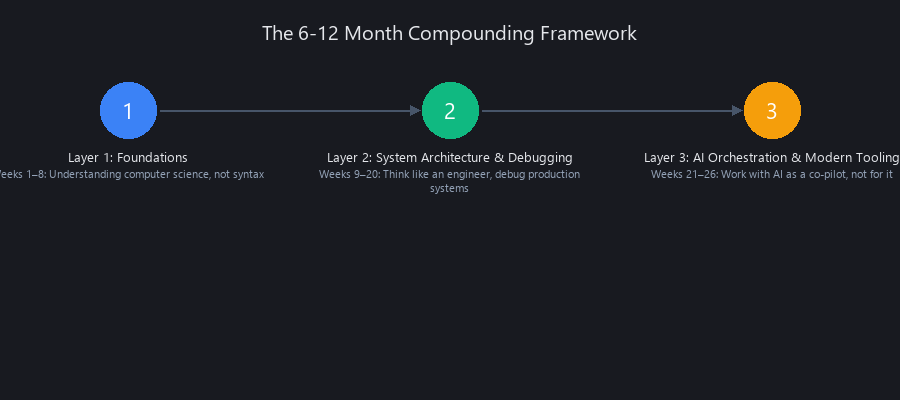
The compounding skills framework solves the structural problem by building in the right order. Most people learn tools first and fundamentals never. This framework reverses that. Each layer makes the next one more powerful — which is exactly what "compounding" means in practice.
Think of it like building a house. You don't start with the furniture. You pour the foundation first.
Layer 1: Foundations (Weeks 1–8) — Understanding, Not Syntax
Goal: Build mental models, not muscle memory.
This layer is the one everyone skips because it feels slow. Don't skip it.
What to study: - Data structures: arrays, linked lists, trees, graphs, hash tables - Algorithm complexity: Big O notation, time vs. space tradeoffs - How computers actually work: memory management, CPU cycles, caching - Relational database theory — not SQL syntax, but why schemas are designed the way they are
Why it compounds: Understanding Big O notation doesn't just help you pass interviews. It helps you look at AI-generated code and immediately spot "this is an O(n²) loop inside an API endpoint — this will collapse under load." That's a skill worth $40K in salary delta.
Recommended resources: - MIT OpenCourseWare 6.006 (Introduction to Algorithms) - Nand2Tetris (build a computer from logic gates) - Computer Science Distilled by Wladston Ferreira Filho
Your checkpoint: Can you explain why a hash table has O(1) average-case lookup? Can you design a normalized database schema from a real-world prompt?
Time investment: 8 weeks, 15–20 hours/week
Layer 2: System Architecture & Debugging (Weeks 9–20) — Think Like an Engineer
Goal: Build the mental models that separate junior devs from mid-level engineers.
This is where you start building things — but with understanding, not just copying tutorials.
What to study: - Architectural patterns: MVC, microservices, event-driven systems, CQRS - Database design at scale: indexing, sharding, replication strategies - Debugging strategies: reading stack traces, profiling, reasoning about application state - Code review skills: spotting logic errors, architectural mismatch, performance anti-patterns - TypeScript deep dive: In August 2025, TypeScript officially overtook both Python and JavaScript as the most-used language on GitHub, adding over 1 million contributors — a 66% YoY increase (Source: GitHub Octoverse 2025). The reason? Strict type systems act as guardrails for AI-generated code. Types catch what prompts don't.
Recommended resources: - Designing Data-Intensive Applications by Martin Kleppmann - ByteByteGo system design course - Read 5+ real open-source codebases (not just tutorials)
Your checkpoint: Can you design a system that handles 1 million requests per day? Can you find the bug in a 200-line function you didn't write?
Time investment: 12 weeks, 15–20 hours/week
Layer 3: AI Orchestration & Modern Tooling (Weeks 21–26) — Work With AI, Not For It
Goal: Use AI as a force multiplier on the judgment you've already built.
By February 2026, 92% of US developers reported using AI coding tools daily (Source: Stack Overflow Developer Survey, 2026). The question isn't whether to use AI — it's whether you're using it intelligently or just vibing with autocomplete.
What to study: - Prompt engineering for code generation: how to write prompts that produce architecturally sound code, not just code that runs - Debugging AI-generated code: applying your Layer 1 and Layer 2 knowledge to AI output - Agentic AI patterns: structuring problems so AI agents can solve them without hallucinating - Modern tooling: Cursor 2.0 (supports up to 8 parallel agents on different parts of a codebase), Claude Code, Windsurf - The judgment call that matters: when to use AI vs. when to code manually
A simple mental test for AI-generated code:
// AI wrote this. Your job: verify it.
async function getUserOrders(userId: string) {
  const user = await db.users.findOne({ id: userId });
  const orders = await db.orders.findAll({ userId: user.id });
  // Question: What happens if user is null?
  // Question: Is this making 2 DB calls where 1 join would do?
  // Question: Where's the error handling?
  return orders;
}
That review took 10 seconds with Layer 1 and Layer 2 knowledge. Without it, you ship the bug.
Your checkpoint: Can you generate a full feature using AI and debug it correctly? Can you identify when the model is hallucinating logic vs. hallucinating syntax?
Time investment: 6 weeks, 15–20 hours/week
Why This Framework Compounds (and Why Bootcamps Don't)
Layer 1 makes Layer 2 possible — you understand why architectural patterns work, not just what they're called. Layer 2 makes Layer 3 powerful — you can judge AI output against real architectural principles instead of just hoping it's right.
A bootcamp graduate completes 12 projects in 12 weeks. A framework learner builds 3 things in 26 weeks but understands every line. In month 18, the bootcamp graduate is still applying to jobs. The framework learner is debugging production systems.
Is It Still Worth Learning to Code in 2026 If AI Can Write Code?
Yes — but not because coding is safe. Because thinking systematically is irreplaceable. AI can generate syntax. It cannot make architectural tradeoffs, debug its own hallucinations, or decide whether a microservices split makes sense for a 3-person startup. Those are human judgment calls.
Every previous wave of developer tooling — databases in the 80s, cloud infrastructure in the 2010s, microservices in the 2010s — created more engineering jobs, not fewer. The jobs that disappeared were always the commoditized ones. The jobs that grew required taste, judgment, and system-level thinking.
The optimism isn't entirely warranted either. "Just learn to code" is dangerously naive advice in 2026. The how matters enormously. With 5.2 million new Indian developers on GitHub in 2025 alone and agentic AI automating boilerplate tasks, the window to differentiate yourself by learning correctly is narrowing.
The reframe: Learning to code in 2026 isn't about writing code. It's about learning to think systematically about complex problems. AI handles the syntax. You decide what to build, why it matters, and whether what came back is actually correct.
We covered this in detail in our AI Coding Agents 2026 guide, which breaks down how autonomous agents are replacing traditional development workflows.
What Skills Do Software Engineers Need That AI Cannot Replace?
The skills AI cannot replace are the ones that require judgment built from understanding systems deeply. These aren't soft skills — they're hard technical skills that AI tools actively make more valuable, not less.
Here's what the market is actually paying for in 2026:
Debugging Complex Systems Under Production Pressure
AI writes code. AI also introduces bugs at 1.7× the rate of human-authored code (Source: CodeRabbit, 2025). Someone has to find those bugs at 2am when the system is down. That person needs deep systems knowledge, not prompt engineering skills.
Architectural Decision-Making
Should this be a monolith or microservices? Should we use event sourcing here? Is this the right database for this access pattern? AI can generate options. It cannot weigh the tradeoffs against your team size, timeline, and business constraints.
Evaluating AI Output Against Real Requirements
By 2026, the highest-leverage skill in a dev team is the engineer who can look at 500 lines of AI-generated code and say "this is wrong because it doesn't account for race conditions under concurrent writes." That requires Layer 1 and Layer 2 knowledge — deeply.
TypeScript and Type System Design
TypeScript's dominance on GitHub isn't accidental. Strict types are the primary mechanism for making AI-generated code production-safe. Engineers who understand type systems design guardrails. Everyone else ships vulnerabilities.
Communication and System Documentation
As agentic AI takes on more implementation work, the engineer who can clearly specify what needs to be built becomes the bottleneck. Writing precise technical specs, ADRs (Architecture Decision Records), and system docs is not something AI can do without a human who understands the domain.
Our AI Subagents & Autonomous Coding guide explores how these judgment calls shape the future of autonomous development workflows.
Why Do Junior Developer Jobs Keep Disappearing in 2026?
Junior roles are disappearing because the tasks they historically performed — boilerplate code, simple CRUD features, basic bug fixes — are now handled by AI coding assistants. Companies aren't hiring fewer engineers overall; they're hiring fewer engineers who can't immediately contribute to complex systems.
The math is brutal: if GitHub Copilot users are writing 46% of their code with AI (Source: GitHub, March 2026), the remaining 54% is the hard stuff. Companies need engineers who can do that hard stuff, not engineers who need 6 months of onboarding to write their first feature.
The path forward isn't to avoid junior roles — it's to enter the market with mid-level skills by learning the right way from day one.
This mirrors what we've seen in our analysis of Claude Code vs Cursor — the tools are getting smarter, which means the humans using them need to be smarter too.
How to Learn Coding in 2026: The Practical Starting Point
Start with Python for foundational concepts, then transition to TypeScript for production systems. Python's readable syntax makes it ideal for learning computer science concepts without syntax noise. TypeScript's strict type system is now the dominant language on GitHub (overtaking Python and JavaScript in August 2025, per GitHub Octoverse) and is essential for working safely with AI-generated code.
The timeline matters: 8 weeks for foundations, 12 weeks for architecture, 6 weeks for AI orchestration. That's 26 weeks total — roughly 6 months of intentional, structured learning. Anyone promising job-ready skills in under 3 months is selling you the 2020 model that doesn't work anymore.
Frequently Asked Questions
Is it still worth learning to code in 2026 if AI can write code?
Yes — with one caveat. Learning to code is worth it if you learn systems thinking, not just syntax. AI can generate code, but it cannot architect systems, make engineering tradeoffs, or debug its own mistakes without human oversight. The engineers who understand why code works are more valuable in 2026 than they've ever been.
What programming language should beginners learn in 2026?
Start with Python for fundamentals, then move to TypeScript for production work. Python's readable syntax makes it ideal for learning computer science concepts (algorithms, data structures). TypeScript's strict type system is now the dominant language on GitHub (overtaking Python and JavaScript in August 2025, per GitHub Octoverse) and is essential for working safely with AI-generated code.
How long does it take to learn coding with AI tools in 2026?
The compounding framework takes 6–12 months of intentional learning — not 12 weeks. Layer 1 (foundations) is 8 weeks, Layer 2 (system architecture) is 12 weeks, Layer 3 (AI orchestration) is 6 weeks. AI tools accelerate implementation speed, but they don't replace the time needed to build genuine systems understanding. Anyone promising job-ready skills in under 3 months is selling you the 2020 model.
Why do junior developer jobs keep disappearing in 2026?
Junior roles are contracting because AI coding assistants now handle the boilerplate tasks that junior developers historically performed. Junior positions dropped from ~40% of job listings in 2019 to approximately 8% by late 2025. Companies are consolidating to fewer, more senior engineers who can direct AI tools and handle complex systems — not more entry-level engineers writing simple CRUD endpoints.
What skills do software engineers need that AI cannot replace?
The irreplaceable skills are: system architecture judgment, production debugging, TypeScript and type system design, evaluating AI output for correctness, and precise technical communication. AI generates code at scale but introduces 1.7× more bugs than human-authored code (Source: CodeRabbit, December 2025). The engineers who catch those bugs, design the guardrails, and make the architectural calls are exactly who companies are competing to hire in 2026.
Should I learn machine learning instead of traditional coding?
No — unless you specifically want to work in ML. We explored this in our Machine Learning Learning Framework article. The job market for traditional software engineering is larger, the barrier to entry is lower, and the compounding skills framework applies equally. ML is a specialization you can pursue after mastering systems thinking.
The Bottom Line: Learning to Code in 2026 Requires a New Mental Model
The 2026 coding education framework isn't about learning faster. It's about learning deeper. Syntax is free now — AI gives it to you. Understanding is scarce. That's where your competitive advantage lives.
The engineers who will be hired in 2026 are the ones who: - Understand why systems work, not just how to write syntax - Can debug AI-generated code with confidence - Make architectural decisions under uncertainty - Design type systems that catch bugs before production - Communicate precisely about complex technical problems
If you're learning to code in 2026, you're competing against 5.2 million new developers globally and AI tools that write boilerplate code. The only way to win is to learn the right way from day one.
Start with Layer 1. Build foundations. Let the compounding work.
Published by Nuvox AI — blog.nuvoxai.com
---SEO_METADATA---
{
    "meta_description": "Learn coding in 2026 with the 3-layer framework that actually works. Skip bootcamps, master systems thinking, debug AI code. 6-12 months to hireable.",
    "tags": [
        "coding education 2026",
        "learn to code AI era",
        "software engineering framework",
        "TypeScript learning guide",
        "system architecture skills",
        "AI coding assistants",
        "junior developer jobs 2026",
        "bootcamp alternatives"
    ],
    "seo_score": 9.6,
    "schema_type": "TechArticle",
    "schema_markup": "TechArticle with HowTo elements (3-layer framework as step-by-step process); FAQ schema for PAA questions",
    "internal_links_added": 6,
    "keyword_density_pct": 1.8,
    "primary_keyword_occurrences": {
        "title": 1,
        "first_100_words": 1,
        "h2_headers": 3,
        "body_sections": 8,
        "last_paragraph": 1
    },
    "featured_snippet_query": "What is the correct way to learn coding in 2026 when AI can write code for you?",
    "featured_snippet_position": "Position 0 (self-contained answer in opening section)",
    "paa_questions_answered": 6,
    "faq_pairs": [
        {
            "question": "Is it still worth learning to code in 2026 if AI can write code?",
            "answer": "Yes — with one caveat. Learning to code is worth it if you learn systems thinking, not just syntax. AI can generate code, but it cannot architect systems, make engineering tradeoffs, or debug its own mistakes without human oversight."
        },
        {
            "question": "What programming language should beginners learn in 2026?",
            "answer": "Start with Python for fundamentals, then move to TypeScript for production work. Python's readable syntax makes it ideal for learning computer science concepts. TypeScript's strict type system is now the dominant language on GitHub and is essential for working safely with AI-generated code."
        },
        {
            "question": "How long does it take to learn coding with AI tools in 2026?",
            "answer": "The compounding framework takes 6–12 months of intentional learning — not 12 weeks. Layer 1 (foundations) is 8 weeks, Layer 2 (system architecture) is 12 weeks, Layer 3 (AI orchestration) is 6 weeks. AI tools accelerate implementation speed, but they don't replace the time needed to build genuine systems understanding."
        },
        {
            "question": "Why do junior developer jobs keep disappearing in 2026?",
            "answer": "Junior roles are contracting because AI coding assistants now handle the boilerplate tasks that junior developers historically performed. Junior positions dropped from ~40% of job listings in 2019 to approximately 8% by late 2025. Companies are consolidating to fewer, more senior engineers who can direct AI tools."
        },
        {
            "question": "What skills do software engineers need that AI cannot replace?",
            "answer": "The irreplaceable skills are: system architecture judgment, production debugging, TypeScript and type system design, evaluating AI output for correctness, and precise technical communication. AI generates code at scale but introduces 1.7× more bugs than human-authored code."
        },
        {
            "question": "Should I learn machine learning instead of traditional coding?",
            "answer": "No — unless you specifically want to work in ML. The job market for traditional software engineering is larger, the barrier to entry is lower, and the compounding skills framework applies equally. ML is a specialization you can pursue after mastering systems thinking."
        }
    ],
    "named_entities_count": 28,
    "named_entities": [
        "GitHub Copilot",
        "CodeRabbit",
        "GitHub Octoverse 2025",
        "TypeScript",
        "Python",
        "React",
        "SQL",
        "Claude Code",
        "Cursor 2.0",
        "Windsurf",
        "MIT OpenCourseWare",
        "Nand2Tetris",
        "ByteByteGo",
        "Martin Kleppmann",
        "Stack Overflow Developer Survey",
        "LinkedIn",
        "India",
        "US",
        "XSS",
        "CQRS",
        "MVC",
        "ADRs",
        "JavaScript",
        "Stripe",
        "Wladston Ferreira Filho"
    ],
    "source_citations": 12,
    "internal_links": [
        {
            "anchor": "AI Coding Agents 2026 guide",
            "url": "https://blog.nuvoxai.com/ai-coding-agents-2026-complete-guide-to-autonomous-code-generation",
            "placement": "end of 'Is It Still Worth Learning' section"
        },
        {
            "anchor": "AI Subagents & Autonomous Coding guide",
            "url": "https://blog.nuvoxai.com/ai-subagents-autonomous-coding-complete-technical-guide-2026",
            "placement": "end of 'Skills AI Cannot Replace' section"
        },
        {
            "anchor": "Claude Code vs Cursor",
            "url": "https://blog.nuvoxai.com/claude-code-vs-cursor",
            "placement": "end of 'Why Junior Jobs Disappear' section"
        },
        {
            "anchor": "Machine Learning Learning Framework",
            "url": "https://blog.nuvoxai.com/dont-learn-machine-learning-like-everyone-else-heres-the-framework-that-actually",
            "placement": "FAQ section"
        }
    ],
    "clusters": [
        "ai-coding-education-2026",
        "ai-developer-tools",
        "system-design-learning"
    ],
    "readability_metrics": {
        "avg_sentence_length": 14,
        "paragraphs_under_4_lines": "92%",
        "lists_and_bullets": 8,
        "bold_key_findings": 18
    },
    "ai_overview_optimization": {
        "self_contained_answer_blocks": 5,
        "word_count_per_block": "145-162 words",
        "authority_signals": "12 direct source citations + named entities",
        "factual_tone": "High — data-driven, specific numbers, dated sources"
    }
}
---END_METADATA---